Marveling at the Marrow ~ Betsy Johnson


 When my daughter and I pilgrimage together, we see dead things. Not intentionally, mind you. We are not visiting reliquary, morgue, or cemetery but forest and beach. And we do not even realize we are on a pilgrimage until we get back to the car. We imagine we are hiking, visiting “someplace interesting.” The Universe, if you believe in that kind of thing (and I do) has other plans.

Our first such encounter took place eight years ago in the Lost 40, a patch of virgin forest in northern Minnesota. If giants needed pencils for whatever giants might need pencils for, this is where they could have found them. In the Lost 40, pine trees that were hundreds of years old rose straight and tall out of a late spring blanket of snow. My daughter and I trudged along the wet deep paths, marveling at the girth of this tree, no, this one!, and there it was—a dead owl. Even now, I’m not entirely convinced that it was dead. It had no visible wound and looked as if it were asleep, a gentle breeze ruffling its feathers that were perfect in the way that seashells and snowflakes are perfect. How could such an arresting fractal beauty belong to a dead thing? The owl lay at the foot of a massive red pine. No tracks or light brushes of wing disturbed the snow around it. An owl keeling over and falling out of a tree didn’t seem possible, but I could come up with no other explanation.

I didn’t ask my daughter what her thoughts were as we stared down at the dead bird, because I was awash with envy. My mind is often a highway clogged with marching ants, endlessly searching for something to feed on, so the calm (dead) owl personified a reprieve from the restlessness always churning inside. What I wouldn’t give to quieten and rest.

My daughter and I finally wandered on, ending our walk by standing at the edge of a hill. The forest behind, a wetland below. Even though snow covered the ground, spring was already doing its work—the trills of frogs rose into the day’s shine. As we stood there, my inclination was to turn back to the owl. Before I could, my daughter slipped her arm through mine and kept me firmly facing light and life.

I wish I could say I learned my lesson that day, but all you would have to do is ask my seat mates on the recent long flights from Minnesota to South Africa and they would tell you emphatically that restlessness still rules the day. Traveling to visit my daughter in Port Elizabeth, where she was doing a semester-long study abroad, I was up, down, and all around in seats better suited for slabs of frozen lamb rather than for living, breathing human bodies. In my defense, one of the reasons I was moving this much was to prevent edema, especially since I wasn’t a year out from a lumpectomy, chemo, and radiation. But it is also because I cannot . . . sit . . . still.

Is it any surprise, then, that hiking kills two seals with one shark: I get to see beautiful things, and I get to move, which turns down the volume on the longing that hounds me wherever I go. And hiking by the ocean . . . well, the ocean, like the night sky, allows me to see my life in perspective—small grain of sand up against The Great Unruly Mystery. The point of standing on a beach is not to explain or control—which I couldn’t do anyway—but to know my place as witness and let my spirit rend with awe.

My daughter and I began our eight kilometer hike toward Sardinia Bay on a small cliff, wending our way down toward the ocean. Sometimes the trail cut through low grass, sometimes the trail was the very beach itself, where walking through the sand was almost as challenging as churning through deep snow back at home. We’d been walking for a little over an hour, talking about a book I was working on when my daughter interrupted me to say, “Is that a whale bone?”

She pointed to a portion of beach on our left somewhat sheltered by jagged rocks jutting out of the water. My first inclination was to say no, it was a gray stone, but we both left the grassy path and stepped down onto the sandy shore to investigate.

The thing sat alone.

“Oh my God, you are right. It’s a vertebrae.”

Waves crashed, seagulls cried, or at least they must have, but I didn’t hear any of it, because on the beach beside my daughter, I was finally able to quiet myself, settle into the space where realization turns to wonder, and welcome the invitation to reverie, to spaciousness and a certain roundness of spirit.

Open and expectant, my daughter and I approached the whale bone.

“It’s huge.” In the Lost 40, my daughter had thrown her arms wide to wrap them around the pine trees. Now she spread her arms straight out like an eagle—the vertebrae reached beyond her fingertips.

We circled it, marveling at the marrow that had dried to the color and consistency of beef jerky. We knelt and pried seashells off it, filling our pockets.

Please don’t make me go into the confessional and admit that I then committed a sacrilege. With my thumbnail, I found a rough edge on the bone and snapped a piece off. It was no bigger than the half-moon of my fingernail, but as soon as I had done it, I felt as if I had stabbed a rusty knife into a sleeping god, all because I could. All because it’s a lie. I said I didn’t know they were pilgrimages until we were back in the car, but that isn’t true. I am always on a pilgrimage, always traveling, wandering, lost in a clutch of thorns, and trying to find any crumb to lead me out.

“I’m sorry. Forgive me,” I prayed to the bone. Yes, I am the kind of person who prays to a whale bone on a beach in front of her daughter. Don’t worry—the voices that hiss inside make me well aware that this is weird. They are the same voices that command me to let all of my old ways die. Be someone new. Be someone different. Someone normal who isn’t swimming in the crushing depths all the time.

Beside the pounding ocean, hush.

Make room for If you weren’t restless, you wouldn’t have come. Or stopped. You wouldn’t have put a shell and a flower on top of the bone, wouldn’t have prayed again and again. You would have walked on, oblivious. You would have missed the other parts of the whale: the giant necklace of its spine, the curve of its rib, the hunk of its flesh. You wouldn’t have been you: one who is willing to be torn apart by awe.

“Thanne longen folks to goon on pilgrimages.” Thus begins Chaucer’s Canterbury Tales. I had to learn the opening in Middle English for a class taught by Dr. L. back in college. He also made us memorize a Shakespearean sonnet of our choice. When he was dying of brain cancer, one of his nurses was an old student of his. As Dr. L. sat in the chair to get his chemo treatment—the same way I have sat in a chair and gotten mine as a nurse double-gloved herself to protect herself from the poison—this past student recited her sonnet to him.

I’m back at home now and I have a CT scan scheduled for next week to check a spot on my lung. I’m back at home now after seeing my child being hugged so hard by the kids she was tutoring in the township that she couldn’t breathe. I’m home after sitting in an open-air vehicle wondering if the huffing rhino was going to charge us or not. I’m home after going on another pilgrimage with my daughter, after which she said as we climbed into our car, “I wouldn’t have wanted to share that with anyone else in the world.”

On my windowsill sit two tiny red seashells that I gathered from the curve of a whalebone. In the space inside, a wild ocean they sing.


12-Step Plan For Becoming The Mother of An Addict ~ Kirsten Wasson

One: Meet guilt, your new best friend. Guilt will be there for you during difficult times: at 2am, for instance, when you don’t know where your twenty-four-year old son is, and haven’t for five days and know he’s using and in a bad way and his phone is off  and you are tortured by images of his eating out of garbage cans, or lying on the floor high and mumbling nonsense in a filthy room with a bunch of other heroin addicts, or trading sexual favors for dope, or dead. Guilt will be right there because the only way such things might be possibly happening to the person you love most in the world is because you fucked him up royally. This is  the easiest part about being an addict’s mother. Because you divorced his dad when he was small, you married and divorced again, and your son saw too much arguing and too much drinking. And, of course: he came out of your body. Who else’s fault could it be?

Two: Embrace alienation. As an addict’s mom, you will be so alienated that you’ll look at people like you talking about their kids struggling to keep up in law school or having started a new job, or breaking up with a boyfriend, and you’ll picture that kid dead in an alley so that you don’t pull your friends’ hair, kick her in the knees and say: Shut the fuck up. So, picture her kid dead in alley so you don’t hurt your friend. You should keep your acquaintances…although you are so alienated you can’t remember why. And don’t think Al-Anon will help much. Al-Anon is like your husband patting your hand after twenty hours of labor and pushing for three hours, though they said in Birth Class it would be forty-five minutes to an hour. But then, after the forceps guy came in, the baby and your body negotiated some internal agreement, and out he came, slimy, skinny, long, and looked at you openly, blindly and you looked back and thought I can’t believe you came out of me. My baby, my son.

Three: Be ready for the verbal abuse. When he catches you snooping in his room, down on your knees, your arm wedged behind the bookcase. Get out, you fucking bitch. What the fuck are you doing? I told you I’m clean. When you drop him off at college, after the third rehab, with his linens and suitcase and new clothes and he turns his back a minute and you peer into his gym bag and see something that says Quick Fix: Privacy Protection Kit and realize at once that, though he took a urine test yesterday as per the agreement about attending college, he has a kit with fake urine and hand-warmers (to heat the urine) to pass the test. When you point at it, he screams at you. He’s told you to go fuck yourself so many times. This time he’s yelling it at the college where you work. Someone around here may recognize you as Professor Wasson. Years later, when he says it when he’s living with his first serious girlfriend and she says Don’t you dare talk to your mom like that, you want to cry. You’ve gotten so used to this abuse, and are always surprised and grateful that he has never tried to hurt you.

Four: Prepare for out-of-body experiences. Of course there is no such thing as preparing for this, so just don’t be surprised—when, after he drops out of college you are standing in his dingy apartment with the shared bathroom, and you see a razor on his desk—if your body is no longer standing. You thought he’d been sober for two months, since the post-college rehab. The razor is used to mince what is probably Vicodin–for sniffing. You learned about snorting pills a year ago. He’s down the hall in the bathroom, and you feel yourself floating above the desk, the razor, the powder. The last two months slip through your mind: what were the signs you missed this time? The late night texts that are philosophical and confusing? The fact that he has a minimum-wage janitor job and doesn’t seem to mind? You thought those might be signs of sobriety. You don’t know where the ground is. You are floating above a scene you know little about, like a cloud, or a ghost, in your son’s life, observing and not understanding. Words swim around you: opiate, addict, recovery, relapse. You’ve been taught these words, but this is a dialect you don’t want to speak. And your son is coming back down the hall and suddenly your feet are on the floor and you are watching him glance at the desk and glance at you. You are back in your body. It weighs a thousand pounds.

Five: Enjoy the good times. When your son is in rehab, the social workers, other clients, and administrators will tell you that he is remarkable. Over and over, you will hear about how empathetic, thoughtful, emotionally aware, funny, smart, responsible, and just plain amazing he is. You bask in this. After what some teachers and neighbors have said over the years, here are people seeing your son in his glory. At rehab. When he’s first out of rehab, and you see him being sober and getting a job and treating his girlfriend with respect and telling you that he loves you and you are the only person who will ever understand who he is and what he has gone through, you will feel warm and glow-y and go to sleep thinking about what a good boy he is and what a good man he is trying to become. And then of course, you will need to learn to enjoy the times when he’s using too. So far it seems moderate, just alcohol and pot, and he’s keeping a job and paying his rent and eating well. You are in a bookstore together and he finds a children’s book about a mouse and a strawberry that you read to him one hundred times when he was five, and he brings it over to you in the new fiction aisle, and he says, “Mom! Remember this?” You do.

Six: Expect to lose yourself. Your decision to focus on yourself and move across country and meet new people and write and get new work is a story hijacked by the story of your son’s addiction, which reared its head two months after you moved. He got sober though, after you flew him out to a great rehab near you. His sobriety lasted for two and a half years, during which time you did some pretty amazing things like become a storyteller and meet cool people and have some crazy dates and get used to living in a warm, beautiful place and find a new job. But then he relapsed. In order to find yourself again you’re going to have to hold onto or dig up again—your story. In between driving out to Griffith Park at 2 am where he is wandering and mumbling drunk and high after driving into the freeway barrier making his car un-drivable, in between talking to his friends about how bad it is this time, in between buying him gift certificates at Ralph’s and seeing his new room in place for recently homeless men in a dilapidated, close-to-poverty line neighborhood, and in between listening to him tell you he is drinking but not getting high. Expect to lose yourself in wondering and worry. Which you deserve because this is your fault. He came out of your body. Who else’s fault could it be? And because he came out of your body you have been thinking that you are the one who can save him. So far that hasn’t worked.

Seven: Never say Never. At a certain point, you accepted, understood even, the daily pill-snorting along with vodka swilling and pot smoking. Your addict boy is a young man who never learned to handle stress since he was fourteen without abusing substances. He’s had a lot of stress—your coming un-hinged when your parents died within 6 weeks of each other when you were thirty-seven and he was six, his Type 1 Diabetes diagnosis at ten, your two divorces, and something he’s hinted at that he would never tell, something that might explain why “I’ve never felt whole, Mom.” Then you find out by checking his phone while he’s sleeping at your apartment on Thanksgiving night that’s he’s been doing meth. That’s something you never thought he’d do, just like you thought back in New York that he’d never use heroin. As he breathes and dreams on your klonopin online order couch you check the internet to look up the word “Chrissy,” which at first you thought was a girl but then see it’s a user’s term for crystal meth. He has promised to go to rehab again, which he does the next day but not before he becomes obsessed with finding where in your apartment he hid his last bit of “Chrissy.” You let him look because by this time you know that addicts almost always go into rehab fucked up on their drug of choice. Why did you think he’d never use heroin? Why did you think he would never use meth? Because you thought he was “better than that”?

Eight: Realize that there will be new and interesting characters in your life. Like John, the man who takes what you hope is a fatherly interest in your son after they meet at a rehab, then are roommates at sober living, and after they are tired of the sober living house, decide to stay together at cheap hostels in Venice. John’s light blue eyes and stubby fingers give you the creeps, but your son likes him and John is helping your son financially, which you try to appreciate without thinking about it too hard. When, after four months of living in hostels with John, your son admits to using and agrees to go back to rehab, John calls you, furious that he has paid rent which he says adds up to over two thousand dollars, and which you now owe him because things haven’t worked out as he planned. He calls you a sick cunt and says he knows things about you and where you live. After a few days of texts that say the same thing over and over you block his number and look into getting a restraining order. From rehab, your son orders a baseball bat and barbed wire from Amazon for you. He doesn’t realize the barbed wire is actually made of silk, a decorative notion for crafting. You send the bat back to Amazon, but keep the silvery thread, fingering it like a talisman. You will never actually meet Gaby, the over a decade-older woman who falls in love with your son at a Nar-Anon meeting and with whom he lives after a rehab two-month go ‘round. She is Japanese and her father, your son tells you, is in the mafia, the Yakuza, a bona fide assassin, and they are billionaires. Gaby’s ex-husband takes care of their six-year old boy in Japan. Gaby and your son live in a luxury loft downtown; she kicks him out occasionally and you let him sleep on your couch. He tells you she is crazy and mean. He gets a tattoo on his chest with her name on it. Every time you see him, he is thinner and always wearing brand new designer clothes. He looks like a well-dressed Ken doll, gorgeous and without internal organs. He admits they are shooting meth together. Gaby and he are together for five months until she says she is going to commit suicide because he doesn’t love her enough and then she disappears from their apartment.

Nine: Forget about enjoying holidays. On most Christmases, you buy him small presents like socks and books and he gets you a card. You cook dinner; he smokes cigarettes on the patio and you eat together with quiet reserve, separate resentments. The card he gives always says “I appreciate everything you’ve done for me, Mom,” and sometimes you feel touched and sometimes you think, Talk is cheap. While he is with Gaby, he does not call or text on Mother’s Day; this is a first in two decades. After he’s back in rehab after Gaby, who did not kill herself but went back to Japan, you book a flight to New York to see family and friends for Christmas. You spend Christmas Eve with him and fly on Christmas. He’s surprised and hurt that you’ve made this plan. On New Year’s Eve the rehab calls and says that for a week he has been acting in an agitated and belligerent manner, and when a counselor reported this behavior to the insurance company, they refused to pay for any more time. He has to leave in 24 hours. You reschedule your flight back to L.A., leave the next morning, then spend the next few days driving around the valley together trying to find a sober living home. He is agitated and belligerent, and it’s raining. Nevertheless, you laugh hysterically together in a Von’s parking lot during a freak thunderstorm when your son pronounces “this New Year’s really takes the cake, Mom.”

Ten: Be ready to practice your math and history. After the tenth rehab/sober living house, you will struggle to remember when, where, how? But not who. It’s always your son. And it’s always you. His father, snug on the East Coast, has never driven him to a rehab, even when he lived in the same town as you and your son. So forget counting because, does it really matter? And the history? Chaotic and much of it still invisible. What triggered that relapse? When, exactly did he start using? How did I realize? Does that help you understand this story that has, on and off, hijacked your own? You wish it would. You make lists and timelines.

Eleven: Love your fellow Mothers Of Addicts. You will meet them on FB sites that no one else knows about, or on planes when you notice the bracelet that says, tackily and beseechingly: SERENITY. No matter what they look like, dress like or talk like or how they have lived, you honor and appreciate them. These are the mothers who say “Good News: My daughter is in jail!” They are the mothers who sometimes wish that their child might die. One has to have lived many years wondering if their child will overdose today or next week before wishing this anguish could be over. One has to have felt there is no hope for their baby, the human being they breastfed and read to every bedtime, taught to ride a bike and how to sweep the kitchen floor, and helped them understand why their bodies were changing during adolescence. We were no different than most mothers, until we realized we were.  The Mothers of addicts know what it means to have a child in the hands of a devil.

Twelve: You will come to believe in God and the devil. Not all the time because you have always been an atheist. But no matter how much meditation, nor how many spiritual retreats you attend, the only thing that will really speak to you when he relapses for the thirteenth time and he’s wandering shoeless on a sunny street in Marina Del Ray carrying a garbage bag of clothes, and is unwilling to get into your car because it’s “filled with cameras wired to the police department,” and you understand this to be full-on meth psychosis (never say never) is that there has to be a God. There has to be some metaphysical beneficent guiding force that will help your son. Or you don’t know how you will go on.

One Extra Step: Hope, maybe. When you see chubby infants and toddlers, or lithe adolescents goofing around in the pool you will think: he was just like those beautiful creatures. But was marked by something. A darkness? You will want to give birth all over again and do everything right. You can’t. He has to give birth to himself. And when it’s two months after the something-teenth relapse you will meet him at the new sober living (dirtier but more welcoming than the last one) and pay the rent and then take him grocery shopping. When he chooses vegetables and fruits with some care, and tells you that he knows you are broke, and does plan on taking care of you eventually, you want to curl up in the cart and have him push you up and down the aisles. And when he puts the bags into your car, then returns the cart to the place where responsible people return carts in the parking lot, you marvel at this newfound interest in order. For two years, he has put cigarettes in your potted plants, dropped paper cups on the curb, and left behind his precious art supplies, treasured gifts and books, as he cycled through one period of health-then-disease after another.

Through the rearview mirror you watch your son push the cart into a long line of carts, an interlocking puzzle piece sliding into place. He puts his hands in his pockets. He walks toward the car.

How Substandard Closet Design Inflamed My Chronic Dread ~ Cris Mazza

People lose things when they move.

Losing things is my habitual worry and a worrisome habit. This, I think, is one reason for science’s relentless struggle to control chaos. Or it’s my persistent effort.

Mercifully anxiety over losing things is soothed by the very method that helps not lose things: order, precision. Important things like car registrations and deeds to the house, life insurance, the 15-digit code that identifies software, keys to the back gate, manual for the refrigerator or cell phone, hardware for picture framing or fixing a hose, devices to cover electrical cords running along the floorboards, filters for the humidifier, sticky-backed Velcro for mounting the tollway transponder, attachments for each of the 3 different shop vacs, a wallet I used in the ‘80s when I carried a purse, photos of my great-grandparents. I can put my hands on almost anything I need when the need arrives, because I know where it is, because I stored it in a systematic way.

But I’m not a hoarder, not much of a magpie. Giving bundles to thrift stores is also a stress reliever, an anxiety quieter. Even writing about it has been useful:

…  Then she loaded her boxes of winter accessories—scarves, gloves, sweaters, wool socks and boots—into her car and drove them to the Salvation Army. The next day she emptied [her unpacked] suitcase into bags and made the trip again . . . When she climbed a ladder to put the suitcase back into the closet, she took down framed posters she’d been saving to put on the walls after re-painting someday; box games of Monopoly, Uno and Tile Rummy; and a briefcase she’d carried in college. She took them all to the Salvation Army.  Then she went through the linen closet and removed fancy lace-edged pillow cases, a stadium blanket, place mats, a table cloth, curtains, guest towels and a box where they’d always put interesting articles clipped from the paper. As she woke each morning she thought about that day’s trip to the donation center and what she would take. Vases, platters, pitchers, trays, salt and pepper shakers. Books, records, nick-nacks, dusty macramé wall art. An empty aquarium, baseball mitts, hanging plant pots. Then some of the smaller pieces of furniture started to go, bookcases and end tables, plant stands, a coat rack. On Sundays, when the collection center wasn’t open, time crawled, she was restless and frustrated, tried to sleep late but couldn’t, glancing often at the black garbage bag waiting by the front door to be taken out first thing Monday.

                                                                                                                 Dog People 1998

Mostly it hasn’t been clothes in the bags awaiting the next trip to the donation center; I buy most of my clothes there. My jeans march steadily down three shelves in my closet, from best (although bought used) to dog training jeans to garden jeans. It takes several years before a pair can’t even validate its place on the garden jeans shelf, and by then the fabric that remains might be used to patch some of the others. Still, some clothes do go into the donation bag, if I hope the style will never come back, if it attracts and embeds too much dog hair, if it’s too girly (from a time I thought I should try harder), if it doesn’t pass a physical or emotional comfort audition (worn to work for a day to see if I don’t notice wearing it).     

Clothes and shoes don’t get lost, they only take up too much of the vital space for arranging other things that might be. Organization. Maybe uber organization. And then re-organizing. The modus to simultaneously facilitate not losing things and to sift out what gets sent to the donation center. This also allows both cars to live inside the garage, allows half my basement to be left bare for dog training, allows two people to cook in a kitchen that only has two counters and two drawers.  Order. Authority over chaos. The fundamental anxiety reliever.  Shelves, shelf organizers, drawers, drawer organizers, designated and outfitted closets for specific needs from supplies to archives, all-the-same-size boxes with labels.  These are some kind of serenity.

But people lose things when they move. Thrown away or given away without remembering. Stashed in a “misc.” box with no other label, and there might be fifteen such boxes, some not unpacked for years (not in my basement). Something loaned and not returned at the previous residence. Something stored in a place no one remembered to pack, an attic or under the stairs. The thing might then forcibly pass the “if you don’t use it in a year, get rid of it” test. But what if it were a photograph or a letter? Do I really want to read any of the letters I wrote to an ex-husband while I was in graduate school in Brooklyn and he was living in our rented shack in San Diego? No, I never will, and I really have considered a bonfire. But the box is labeled, tied with string, and stored where I know it is but won’t see it unless I had to go look for it, which I won’t have to. Why is this important? I can’t say. I just know where it is.

Most of my mother’s slides as well as her mother’s photo albums are put away and labeled, maybe not as archive-protected as they should be in humidity and acid controlled environments. At least they’re not in the basement which gets damp (although a dehumidifier runs nonstop). Most importantly, I know where they are. A large scanning and digital storing project is planned, so they await, along with a box of slide-organization tools—light bar, slide sleeves, slide bins, etc. The un-started status of the project creates no affecting angst; it’s knowing where they are that’s soothing.

Admittedly, order is easiest with mementos and/or artifacts that I won’t be using or even accessing. A Civil War era blue shawl worn by my maternal great grandmother at her wedding in Southport, Maine.  A tablecloth and napkins my mother made in the 1940s as a gift for her mother. A patchwork quilt I made with my mother in junior high as a Girl Scout project: each vacuum sealed and stored in a separate matching box, top shelf of main floor closet.  Dog show plaques (ribbons and trophies discarded), dog title certificates, dog show records, VHS and 8mm videos of previous dogs I’ve shown awaiting another large project of digitizing, a swatch of hair from each dog stored in a zip-lock baggie, a few puppy teeth, one nasty foxtail that had to be surgically removed from a dog’s groin, bundled and labeled in same-size boxes.  Paper items upstairs, plaques in the basement on shelves dominated by boxes of the books I’ve authored, which, despite being paper, cannot be stored in the closets upstairs. They may well rot down there.

Those things whose use is required, whether only occasionally, weekly or daily shouldn’t live in peril of being lost, but always have higher risk unless put away after each use in the same spot where they came from and can therefore always be found when needed.  Scissors, hole-punches, staplers and staples, exacta knifes, packing tape, twine, twist ties, electrical ties, rubber bands, garden seeds, the metronome, saxophone reeds, saxophone repair materials, any building or painting tool, assorted hardware (organized by type and size), batteries, flashlights, light bulbs, attachments for the four different vacuum cleaners, music CDs (arranged by artist and genre) and movie DVDs (not enough of them to systematize), still also a few VHS movies that I “need” to watch every few years and haven’t yet replaced with DVDs. An exhaustive enough sentence to make my point.

I was sure I didn’t lose anything in my last move. I was accorded plenty of time, no rush to pack and move during the escrow process. So, while the new house was being painted, re-trimmed, carpeted, and a bathroom upgraded, I prepared the storage areas and closets myself.  Paint, organizers, and a plan: Two closets were reassigned from the usual job of holding clothing, turned instead into structured areas for stuff from office supplies to personal files, photographs to software CDs, archived records of now dead show dogs to promotional copies of my books. The closets that still housed clothes and coats also needed sculpting to hold additional shelves for a collection of baseball memorabilia, blankets, suitcases, the few games I’ve kept, and I’ll have to end this list with the disorganized word etcetera.  Then: What items could be stored on the row of shelves in the (possibly damp) basement and which required the first or second floor. Which items might need better access (from certain musical instruments to vacuum cleaners), which could be more difficult to retrieve (other musical instruments to outmoded film cameras). Lastly: which shelves had to be double-braced because they would hold books, photographs, or archived manuscripts. Which could be wire (flat objects and boxes) and which should be solid (photo albums and books).  Could shelves wrap around all three walls of a closet or which side walls had to be left blank to allow drawers on center shelves to open. 

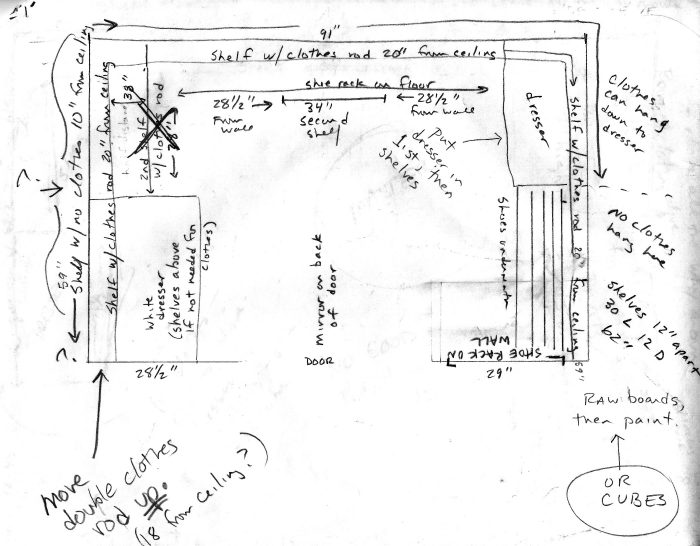
I planned the closets in pencil on graph paper. I took the design notebook with me to doctor, haircut and vet appointments and poured over the plans in waiting rooms. I had lists of measurements of everything, from how tall and wide the saxophone and trombone cases were when standing on end, how much vertical room a row of shirts would need (so I could install a dual row of shelves with clothes bar and maximize space); plus what sizes board and wire shelves did I already have — uninstalled from the previous owners and scrubbed in the tub or from my previous house, hardware saved in baggies and taped to each.  This is why boys used to take drafting while girls had home economics in the ‘60s. I had neither in the ‘70s. 

My diagrams almost worked. Strong enough, wide enough, space between shelves, space under shelves. Well . . . the archive and office boxes had to be tipped completely ninety degrees and sideways to be lifted up onto the highest shelves because the front edge of the shelf was too close to the front wall of the closet, leaving not enough room for a normal forty-five degree overhead straight-on placement. The triangular braces making the shelves mega sturdy, which had to be mounted into wall studs, were spaced just badly enough that my matching photo storage boxes couldn’t all fit beside each other on the shelf below. And on the lower row of the dual clothes-hanging shelves in the walk-in bedroom closet, even with short jackets assigned to hang there, hid the shoe rack mounted near the floor. Plus that lower clothes-hanging shelf proved to have a second and even more flawed design.


Meanwhile, I discovered I had lost something.

I’ve had a foot massager for over forty years. My father gave it to me for Christmas my first year of college. After four years of marching band in high school, mostly as a parade band, marching heel-first on pavement (as opposed to toe-first-on-grass when I got to college marching band), I always had aching feet. I didn’t wear flats or heels, my shoes were always tennis shoes or some kind of crepe-soled oxford (Wallabies a favorite, but I must’ve had knockoffs.) When Earth Shoes came out, I thought they were my answer. I was mostly seduced by the androgynous clodhopper styling, but the promise of returning my feet to their indigenous way of walking lured me as well. After classes, which for three-days-a-week meant after marching band rehearsal, I rushed off to my part-time job as a nurse-aide at a state ward for severely disabled children. On my feet there for another four hours. The nurses and other aides started buying their requisite white shoes in Earth Shoe styles. But when I came home with a pair, my father took a rare notice of an aspect of my wardrobe (why should he bother to notice, let alone disapprove, when I was almost always in jeans). He insisted, demanded, that I return the Earth Shoes. Yes, he had a reason, but I don’t remember. Bad for my back? My ankles? Unnatural to walk with the ball of the foot higher than the heel? Obviously I argued that my feet hurt at work, but I took the shoes back. And that Christmas my dad, who we called the great gadget-giver, gifted me a Dr. Scholl’s Foot Massager.

My feet have been better the past decade or two, since I don’t wear sneakers almost ever. Still attracted to clodhoppers, although crepe soles aren’t as common, and too many use faux leather and don’t last. Real Wallabies are over $100. But I’ve remarkably kept myself supplied in barely used Sketchers oxfords from thrift stores. Still, I always kept the massager plugged in under my desk so I could use it when I ached from long days at dog shows on concrete-floored fairground buildings or from cooking sock-footed on a tile-floored kitchen.

Then, after this last time I moved, I couldn’t find the foot massager. I didn’t seek it out until I’d been in the house for six months, was thoroughly unpacked, my closets humming along in the systemized organization born from my plans. Every few weeks I searched again in all the reasonable places, from the master bedroom upper closet shelf that held blankets, a suitcase, two office boxes of baseball memorabilia, a plastic bin with four purses I only occasionally, by particular necessity, use. To the basement in three plastic containers labeled respectively “wheeled tote bags,” “film cameras and lenses,” and a mixed bin of “jack knives, back-up cell phones, landline phones, and label-maker.” To the cabinet in the family room where there was a space for the massaging wand I’d acquired more recently beside three stacked plastic video drawers holding the BETA movies I’d taped in the ‘80s (the BETAMAX itself in a vacuumed-sealed bag in the basement for future use with a third TV mounted in front of the exercise equipment). To the supply closet in my study, to the photo and music storage closet in the other bedroom, and back to the master bedroom, where I could look up through the upper wire shelf and would see it if it were there, tucked between stacks of blankets. 

Had it somehow gotten into a thrift-store donation bag? How could that happen by accident? Had I left it at the old house so it was discarded when my ex-husband moved out after me? But he would have called and, laughing, said “what’s this ancient thing, do you want it?” Dejected by lack of use, had it walked off on its own? How do people lose things when they move? How was I now one of them? How could I have something for so many decades and then suddenly it’s gone? It was just an old fashioned vibrating motor with two places to put my feet, not my identity, not my heritage, not my lineage, not my history, not my intellectual and artistic archives, not the photo record of places I’d been and people I’d been there with. But it was a gift I never would have expected in a million years, and yet so appropriate, and so comforting for so many years, and had been given to me by my parents (who must have been tired of hearing me complaining about my aching feet). Had I finally moved around too much, and too far away, that I lost part of my connection to something larger? Isn’t that what we really mean by the symbolic end of childhood?  

In 2014, when my Mom went into hospice for congestive heart failure and my dad lost thirty pounds and four inches, I engaged in another obsessive search for what could be lost: my paternal genealogy.

A decade-and-a-half ago, in another period when retreating from all reality seemed not just prudent but crucial, I had pulled out a thick typed-and-stapled genealogy research project completed by my mother’s cousin, tracing my mother’s maternal lineage back to the sixteenth century Earl(s) of Mar. (Another group of distant relatives had started the project to try to lay claim to some of the Earl of Mar’s estate. It seems there was a bastard son who fled to the U.S. in the early 1700s; plenty to facilitate my escape from post 9/11 reality.)  As my parenthetical excursions demonstrate, I became so enthralled in imagining the lives at each generation (enhanced by the mysteries of those who died young, men who used up multiple wives and had over a dozen children, two sisters marrying two brothers, etc.), I based a novel on my maternal genealogy, the searching, and the utter panacea in the escape of imagining. Escape which, in the novel, could not ever be complete nor be maintained.

My ancestry and cultural heritage through my father had always been the dominant “tradition” and the family we most visited in my childhood, so I’d promised I would someday trace his genealogy. I started in November, 2014. Stymied at first, I couldn’t go back father than two paternal generations. Family lore had told me that my Mazza grandfather had come from Italy when he was fifteen, which would be around 1908, but I couldn’t find a record of this Mazza family on any shipload of immigrants coming into New York from 1900 through 1920. The range was narrowed down by the federal and New York censes which recorded the morphing family from 1920 through 1940 and suggested the immigration date (which was asked on the census) as 1910. But none of the censes (in early searches) gave the name of my father’s grandmother. (My father was no help. He never knew her.) I was stuck, already, three generations back, and couldn’t even find the immigration documents.

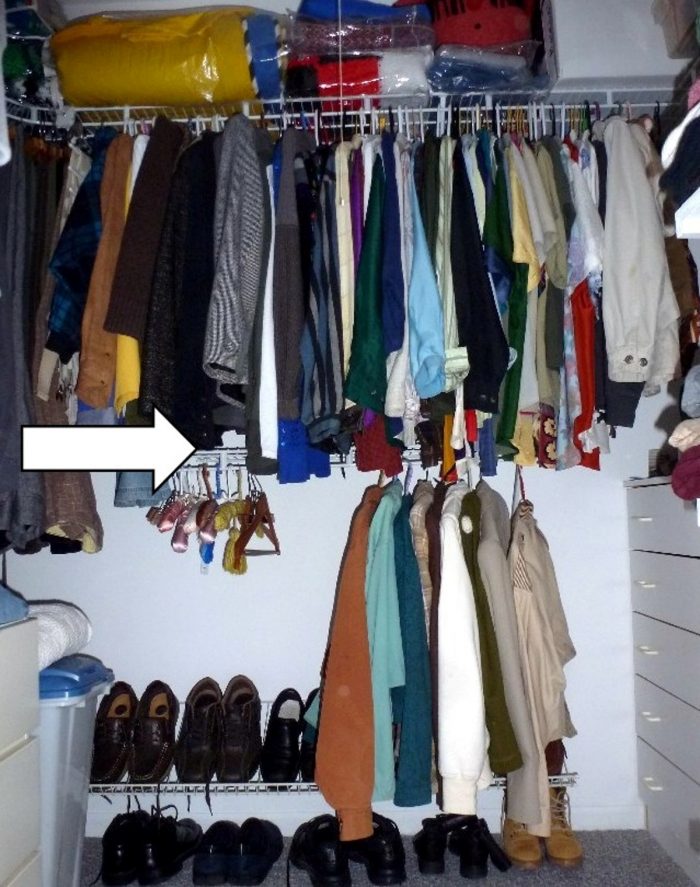
The ancestral disarray thrumming on my mind, I paused on a bathroom trip to get from or put something into the bedroom closet, and was distracted by the now two-year-old but suddenly even more conspicuously poor closet-organizational design. I’d put the shortest jackets on that lower clothes rod, and they were still blocking the view of the shoe rack below. Sure there were shoes on the rack, but what good was it if I couldn’t see them? And for that matter, that lower clothes rack itself was a shelf that was hidden by the shirts hanging on the upper clothes rack (see arrow). 

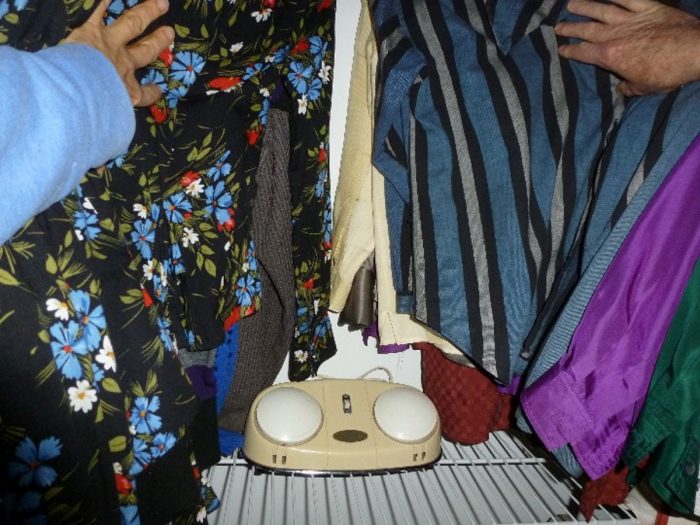
I’d planned and installed a shelf into my closet that obviously could not hold anything because not only would the shelved item cause the shirts to bunch up and wrinkle, but nothing on the shelf would be visible. As if to prove that this useless shelf was hiding there, I put my hands into the row of blouses and parted them like curtains.

And there was the forty-year-old foot massager.

As I grabbed it into my arms, the shirts swayed closed over the now empty impractical shelf.  (Yes, the photo had to be re-staged.)

Did restoring this forty-year-old Christmas gift from my father allow me the breakthrough in my genealogy search? I’d like to think so. With it in its proper place under my desk (plugged in so I could flip the switch with one foot and rest my arches on the buzzing upside-down cups whenever necessary), I located the misplaced immigrants, including the missing great-grandmother, Fortunata.

With a different search on a new database (one that accessed Ellis Island records), I was able to ascertain that whoever logged the family into the manifest for the passenger ship Oceania either mis-heard the surname or in heedless sloppiness penned the letters poorly. Decades later when the name was entered into the digital files for Ellis Island, the name was read and typed as “Marza.” Uncovering this error, therefore finally finding the family on a manifest, was only possible because on the same voyage, the Oceania’s records included a list of passengers who were “held” pending a medical authorization, and the Mazza family is listed there, spelled accurately, with the correct first names for the males that I knew to look for, and all the names matched the first names of those “Marzas” handwritten on the manifest. Both lists provided the first name, Fortunata, for the individual designated “wife” to Raffaele Mazza. This women with her own beautiful name had given all three of her daughters the name Maria—Maria Grazia, Maria Elizabetta, and Maria Raffaela. By the time the US census takers were writing the family in their ledgers, the young women were going by steadily more Americanized middle names, Grace, Eliza, and Anne. Until they disappeared off the last publically available census in 1940. Probably they had married and moved and lost their original surname.

I’d have never found Fortunata if the family had not been held for medical clearance and someone actually typed that list instead of using sea-weary handwriting.

What I found in the closet, in a labyrinth of my own design, in a hiding place I’d been the one to painstakingly create, seems more than a vintage machine to ease my oft aching feet. The solace of discovering that it was not lost was then strangely equal to the odd comfort of finding those Mazzas, held on their ship for muddled bureaucratic reasons, hidden by a careless misspelling, not a flawed design.

But what did I find? A woman with seven children, three of them named Maria. A woman who died six years after settling in an immigrant neighborhood in Brooklyn, whose grandchild didn’t know her name and couldn’t remember his father or grandfather ever talking about her, even though his father named a daughter for her. A woman carrying her husband’s name so there is no way to look for her lineage. An enigmatic woman whose given name is far more beautiful and evocative than the archaic, wretchedly-colored foot massager, which also carries a man’s name. As do I—my father’s.

Debra Marquart

Debra Marquart is a Distinguished Professor of Liberal Arts and Sciences at Iowa State University and Iowa’s Poet Laureate.  Her work explores the relationship between the spoken word, the literary arts, storytelling, and music. Marquart has published six books, including Small Buried Things: Poems, and The Horizontal World: Growing up Wild in the Middle of Nowhere, and she continues to perform with her jazz-poetry, rhythm & blues project, The Bone People, with whom she has released two CDs: Orange Parade (folk/rock) and A Regular Dervish (jazz-poetry).  Her work has received over 50 grants and awards including a National Endowment for the Arts Fellowship, a PEN USA Nonfiction Award, a New York Times Editors’ Choice commendation, and Elle Magazine’s Elle Lettres Award, and has been featured on the BBC and National Public Radio. She is the senior editor of Flyway: Journal of Writing & Environment, and she teaches creative writing in ISU’s MFA Program in Creative Writing and Environment and in the Stonecoast Low-Residency MFA Program at the University of Southern Maine.

Daniel Menaker

Daniel Menaker, former fiction editor at The New Yorker and Editor in Chief of Random House has twice won the  O. Henry award for short stories and is the  author of seven books, two of them among the New York Times’ Best Books of the Year, another an Editor’s Choice. He currently teaches in the Stony Brook University MFA program.


Leslie Carol Roberts

Leslie Carol Roberts’ work as an author explores the materiality of ecologies through the lens of the personal essay. Her books include Here Is Where I Walk: Episodes from a Life in the Forest (Nevada, 2019) and The Entire Earth and Sky: Views on Antarctic (Nebraska,2008).  She has lived and worked in Australia, Antarctica, New Zealand, and Thailand, and her writing has appeared in Ascent, The Christian Science buy finasteride online 5mg Monitor, Fast Company, the Sydney Morning Herald, the Bellevue Literary Review, the Iowa Review, and Fourth Genre, among others. She has received an NEA and a Fulbright. As a research scholar, she is affiliated with both the Scientists Committee on Antarctic Research (SCAR) Humanities and Social Sciences group and the Architectural Ecologies Lab at California College of the Arts, where she chairs the MFA Writing Program.

Transit Camp: Myths and Realities of Prague’s Lost Jews ~ Sandell Morse

How strange the air. How strange this place. Austere facades of tall stucco buildings meet the sidewalk at sharp right angles. Tall narrow windows occlude light. No balconies, no window boxes. No trailing ivy. At street level, doors are shut. No one walks. No one drives. Nothing stirs, not a dog or a cat. Squirrels don’t scamper. Birds don’t fly; yet Jakub, my tour guide said people lived here. I stand on the sidewalk as my fellow travelers head for the Ghetto Museum. Jakub disappears. The bus driver, too, has left. This is Terezin, a former Nazi concentration camp, divided into this town called the Large Fortress and a prison, named the Small Fortress on the other side of the Ohre River. The air wraps me like a shroud.

I’d been in Prague for three days. I knew Terezin was close, and I’d done some reading about the camp. Still, I’d had no intention of visiting. I find the idea of concentration camps as tourist spectacles abhorrent. I understand what’s behind these visits – to learn, to see, and to feel history as if the residual pain of others will prevent us from doing what we do, rape, torture, murder, repress, oppress, starve entire populations, spray tear gas on women and children, shoot to frighten or to kill, and turn asylum seekers away from borders. I came to Prague to immerse myself in the city’s centuries-old Jewish history—Prague’s Jewish settlements extended back to the 7th Century—but once I walked the ancient paths of the Old Jewish Cemetery and visited sites in the Jewish Quarter, I felt compelled to come here. Terezin, an hour’s ride from Prague, was the first stop for Prague’s Jews before they were sent to camps in the East and almost certain death.

Most folks—if they think of Terezin at all—recall it as a model camp or a camp that imprisoned children. It was and it wasn’t both. In 1944, before the Red Cross visited, the Nazis emptied the camp of their malnourished, sick, and dying prisoners, replacing them with well-fed, well-dressed new arrivals. They stocked the stores’ empty shelves with cans of food and loaves of bread, staged a soccer game, and assembled Jewish musicians to perform a concert. They showed the Red Cross bunk rooms where children read books and women knit. They showed them a library, and representatives left thinking that life in the camp wasn’t so terrible after all.

In her memoir, Prague Winter, A Personal Story of Remberance and War, 1937-1948, Madeline Albright writes the reality of Terezin: “In a matter of weeks, rooms for four people became warehouses for twenty, then forty, then sixty. Triple decker bunks stretched from wall to wall and floor to ceiling, with two inmates sharing every mattress. When the supply of habitable rooms was exhausted, prisoners were jammed into windowless attics, cellars with dirt floors, and dust-ridden supply closets and storerooms….”

In the camp, sewers backed up. There was not enough clean water. Not enough food. Albright’s grandparents were imprisoned in Terezin, and her grandfather died here. According to the Terezin Memorial website, more than 87, 000 Jewish men, women, and children were shipped to death camps, Albright’s grandmother among them. Of these, 3,800 would survive.

As I press the soles of my sneakers into the sidewalk on this raw, dreary November day, the chill of this terrible story and its legacy seems to touch every cell in my body. I don’t know which way to turn, right and follow the others inside or step off the curb and explore this empty town on my own. What will I see if I meander? Not much. I climb a set of cement stairs. Inside, the Ghetto Museum, I am overwhelmed: glass case after glass case, glass column after glass column filled with artifacts: books, diaries, postcards, photographs, and testimonies of life in Prague, then, here, under the Nazis. This is the museum’s permanent collection: “Terezin in the Final Solution of the Jewish Question 1941-1945.”

What to do with the Jews? The question was Hitler’s obsession. His answer, the Final Solution. I wonder how many visitors understand that Final Solution is code for murder, its blueprint for implementation discussed during the January 1942 Wannsee Conference, a high-level meeting of Nazi officials that sealed the fate of Europe’s Jews.

I want to read every page in every diary, every word in every newspaper. I want to read each identity card and say to each face; I will remember you. So many photographs remind me of my mother, her full cheeks, her sweet smile, her wavy hair—and of my father, his narrow nose, his high forehead, his wire-rimmed glasses. I see photographs of children, girls with their hair in curls or in braids. In 1942, I was a blond-haired, blue-eyed Jewish child bending over a tulip in my grandmother’s front yard. I know because my father snapped my picture.

Terezin was a transit camp for Auschwitz. The Nazis moved more than fifteen thousand children through the camp. None stayed long. A wall displays their drawings, preserved by artist and teacher Friedl Dicker-Brandeis. Secretly, she gave the children drawing lessons. She must have sensed her deportation. She filled two suitcases with more than four thousand drawings and hid them before climbing up into a boxcar.

I stand before a child’s drawing—washed blue background, blue vase filled with blue flowers. The composition is minimal—stark and beautiful. Children have drawn life before Terezin and life inside Terezin, a man and a woman walking along a dirt road, each carrying a suitcase and gripping the hand of a child who walks between them. Jews walked two miles from the rail depot to the camp. In another drawing, men pull and push a wooden cart laden with dead bodies. On the bus, Jakub had spoken of this cart. Later, that cart returned filled with the daily ration of bread. Among the gratuitous cruelties of Terezin was that prisoners were forced to pluck their daily bread from a cart that an hour before had carried their dead.

Earlier, at the Small Fortress, which had long been a prison, our group had filed into a cold, unheated room where we sat on narrow wooden benches and watched a Nazi propaganda film. By 1944, rumors of death camps had escaped, and to counteract those rumors, the Nazis filmed their version of life in Terezin. On screen, a prisoner milked a cow, another shoed a horse. Prisoners swung mallets and welded. Rows of women sat at sewing machines, each threading fabric under a presser foot. In another workroom, men cut out patterns. Outside, prisoners hoed a vegetable garden and filled buckets at a nearby stream. This was work at Terezin, emblematic of the Nazi slogan, Arbeit Macht Frei, Work Sets you Free, painted on an archway as we entered this place, the same slogan painted on an archway at Auschwitz. The vegetables the prisoners grew were not for them; they farmed for the German Military High Command and their families, living in large houses nearby.

The scene switched to a men’s soccer game with cheering spectators, a crowd made up of prisoners. Another scene showed a table set with candles and candlesticks, implying that soon a family would take their seats and welcome Shabbat.

The film was old, the sound track echoing, features blurring, but two things remained clear: the health and well-being of these men, women, and children. As I followed my fellow travelers from the room, I recalled a conversation with a young Czech poet, living in the States. Born and raised in Prague, he’d emigrated when he was twenty. Yes, he’d visited Terezin with his school group. “It wasn’t a concentration camp,” he said. “It was a town outside of Prague where they sent Jews during the time of the Nazis. They were not mistreated, not like in the other camps.”

My thoughts turned to mistaken ideas about Terezin. When Nina, my granddaughter was in the eighth grade, Anna Smulowitz, daughter of Holocaust survivors, brought her award-winning drama, Terezin, Children of the Holocaust, to York, Maine, our home town. Nina had watched the play with her class in the afternoon. I went that evening. Standing in front of a blue velvet curtain, Smulowitz, a short, plump, dark-haired woman wearing glasses, announced that Terezin, Children of the Holocaust was her tribute to her many relatives murdered by Hitler. Opening slowly, the curtain revealed a double decker wooden bunk, an old steamer trunk, and a Nazi flag hanging from the top bunk. Really, a Nazi flag in the prisoners’ room? The six actors, all children or adolescents, wore what passed for period costumes: girls dressed in cotton dresses or skirts with collared blouses and buttons down the front; boys wearing dull trousers, white shirts and newsboy caps. All wore yellow cloth Stars of David with the word jude, Jew, written in black ink and pinned to their sweaters or shirts.

The action took place over the children’s last two days before deportation. These confident well-fed actors with their shining hair and rosy cheeks reciting their lines did not speak to life inside the camp. I’d understood even before my visit that the children of Terezin had been cold and hungry. They’d lost mothers, fathers, sisters, brothers, grandparents, aunts, uncles, and friends. They were confused and angry, depressed and sad. Many were ill. Watching the play, I tried to suspend belief. I wanted these young people to succeed, but when two young actors looked out a window, saw smoke stacks, and seemed to know their fate, I could no longer pretend that I was okay with what I was seeing: distortion. In reality, none in these transit camps knew their destination. Few, if any, had heard of Auschwitz. Rumors of gas chambers—if they reached the camps—were too preposterous to believe. But most importantly for this audience, Terezin was not a killing camp

I wanted to race up the aisle and fling myself into the outside air. I needed to smell spring. I needed to breathe. I hated this play, its simplistic portrayal of a complex reality, its inaccuracies, the inexperienced young actors, the past inaccessible to them. But this was my community, my granddaughter’s community, I could not flee.

In the final scene, three children kneel around a low table and play a game. Corinna, a kapo, a prisoner who carries out SS orders, sits on a top bunk. As a kapo, she gets better food and a chance to survive longer, but for these privileges, she disciplines and often betrays her fellow prisoners. In her introductory remarks, Smulowitz said she’d modeled Corinna on her mother. “Corinna,” she said “was a victim of the situation.”

Sitting in the darkened auditorium, I mulled over the word: situation. A vague word. Orwellian. Used to obscure truth and moral dilemma, rather than illuminate. I watched Corrina read a book and take herself out of the scene. I glanced at the children at the table. None of the actors spoke. The audience waited. All of a sudden, we plunged into darkness, audience and actors alike. This was the end, the abyss. Or perhaps, a negation of what would come next for these children, deportation. Death.

*

The next day, I said to my granddaughter, “So, Nina, what did you think of the play?” We were standing in the kitchen, Nina dipping a rice cracker into a plastic container and scooping up hummus.

“I know what it’s about,” she said. “It’s about bullying.”

“Nina, the play is not about bullying.”

She popped the cracker into her mouth. “That’s why they brought it to York. To teach us about bullying.”

“Nina, genocide is not the same as bullying.”

“That’s what we talked about.”

“That’s all you talked about?”

“That’s why they showed it.”

She licked hummus from each finger, the point of her tongue darting; then, she shoved the container into the refrigerator and headed downstairs to the family room. I called after her. “Dinner in half an hour.”

“I’m not hungry,” she called back.

*

As I stand inside the Ghetto Museum, I can’t stop thinking about these misconceptions, like an arrow missing its mark. I read about a doctor and his family living in Prague, imprisoned here, then deported. The family vacationed at a seaside resort. They posed in the doorway of their home. How soon after these photographs had ordinary life been stripped away? How soon before soldiers had sealed them into boxcars? I thought back to the play. How wrong-headed to use a genocide to teach bullying. Why not explore words like sadism and humiliation? Why not talk of the danger of forgetting evil? In my mind, the lessons of genocide are not transferable; its sole purpose is the destruction of an entire community, a tribe, a people. I think of Bosnia. Of the Tutsis and Hutus.

A touch on my arm. Jakub, his face stern as he taps the crystal of his watch. “I said forty-five minutes. You are late.”

“Yes,” I whisper.

“The others are already in the bus. We must go.”

“Yes.”

As the bus pulls away from the curb, I think of all I have not seen, the town square where in the film, men played soccer. The barracks are long gone, as is the cart that hauled the dead. Inside the bus, we are quiet. Some sleep; others listen to whatever plays inside their ear buds. I gaze out my window. The bleak light of a gray-white sky darkens and descends.

That evening back in Prague, I walk from my hotel to the Spanish Synagogue in the Jewish Quarter. Built in 1868 for the city’s Reform congregation, the building stands on the site of a much older synagogue. Security is tight. The door is locked, and a guard tells me I will need to wait until the rabbi arrives. I wander the quiet streets of this neighborhood, then check back, expecting to see a line. No line. I wander again, check again. Half an hour passes. Now, I wait for the door to open. Inside a vestibule, a guard motions to my wool hat. I take it off. He looks up at my face, down at the photograph on my passport, up again. I remove my jacket and my scarf. He motions. I set my clothing on a shelf, then stand feet planted wide, arms outstretched. A second guard scans my body with his wand, and it is as if I feel his fingers. I think of the churches I have entered freely throughout the city. At home, too, synagogues need security.

Restored to its former glory, the Spanish Synagogue resembles the Alhambra, Moorish in style and decorated with Islamic motifs of brilliant color and gold. The ceiling is high and vaulted. Inside a dome, a majestic stained-glass window displays a six-pointed Star of David. I slip into a seat at the end of the second pew. We are about twelve, clustered inside this vast space, and we are visitors. None of the Czech congregation attends regular services. Mostly, they use this space for celebrations: weddings, bar mitzvahs, and funerals. I don’t know if the congregation celebrates Bat Mitzvahs. Under first the Nazis, then the Communists, families forgot how to be Jewish.

Wearing a yarmulke, khakis, and a raincoat, the rabbi enters through a side door. All of us wear jackets or coats, and we sink down inside them searching for warmth. There is no heat. The service is sung, and although I don’t know the prayers, I know the melodies. I didn’t go to religious school, but I lived in an extended family with my mother, my father, and my Orthodox grandparents. Mornings my grandfather would wind teffilin, phylacteries, and chant morning prayers. I would stand beside him, humming and swaying. He would let me do this; most Orthodox men would not. I had no idea that every morning he thanked God for making him a man and not a woman. Friday nights, the family would gather for Shabbat, my grandmother lighting candles and singing the blessing, and all of my life, the music of her prayer has sung in my bones.

I rise with the others to read a transliteration of the Amidah, a standing worship of praise, petition, and thanks. At the conclusion of the service, we recite Kaddish, the Hebrew prayer for the dead, a prayer we recite at funerals and on the anniversaries of the deaths of loved ones. We remember not only our own family members, but all of our dead. Here inside this cavernous synagogue, I remember the dead of Terezin and bring to mind a child’s artwork inside the Ghetto Museum. In a drawing that echoed Chagall, this child drew two flying figures: one a rabbi wearing traditional dress, black trousers, black coat, black wide-brimmed hat; the second, a man casually dressed and hatless. The hatless man holds the string of a kite. A speech bubble shaped like the stone tablet of the Ten Commandments and filled with Hebrew letters spills from the rabbi’s lips. I wondered then, and I wonder now. Why a rabbi? Why the Ten Commandments? Was this young artist embracing religion? Mocking religion? Was she imagining ancient Judaism flying into eternity? Was she thinking of death and seeing souls fly away? Was she hopeful? In despair? I saw survival in that drawing, a rabbi holding onto the Ten Commandments, a man gripping the string of a kite, both flying, not up to the heavens, but over the camp that lay below.

After the service we gather around the rabbi. He lifts a Kiddush cup and blesses the wine. I step outside into the chill of the night.

Other Minds ~ Daniel Menaker

Maxwell can do the following tricks, at spoken and/or manual commands, each trick rewarded by a small treat: Sit.* Shake hands, right. Shake hands, left. Lie down. Cross left paw over right.** Roll over (prefers bed or rug to bare floor). Walk 360 around me to the right and sit. Walk 360 around me to the left and sit. Turn around two or three times in place. Front paws up and over my forearm parallel to floor, head over arm. Front “ “ “ “ “ “ “”, “ under” “. Stand up on back paws, 360 degree revolution (American Ballet Theater Award for Worst Pirouette, 2012, 2013, 2014, 2015, 2016). Go between human legs, turn around, come back between legs, turn around, but only if outside edges of human feet are against something—a wall, a doorway—that is unskirtable. Otherwise, on the way back, Maxwell will go outside the feet. Generally he seems not to like going under things.

Teaching him these tricks was remarkably easy. Each one took just two or three days of two or three fifteen-minute sessions. The paw-crossing one—the one that earns the most oohs and awws, the one that I’ve never seen any other dog do (though surely others do), was the easiest. I just said, “Maxwell, cross your paws,” pointed to his left paw, picked it up and put it down across his right paw, and gave him a treat. Soon all I had to do was say the words, point to his left paw, move my hand, index finger pointing, from right to left (Maxwell’s left to right), and “Viola!” (as I read “Voila” when I was nine or ten). Now all I have to do is either say “Cross your paws” or motion with my finger.

Border collies and other herding breeds and smarty breeds can follow dozens of commands— whistles, words, and/or hand signals. People say that dogs “love” following the commands they understand, as I would say that Maxwell apparently loves doing his tricks. Herding dogs will spend hours following commands with no rewards at all—and even doing their work with no commands and no rewards at all, except, apparently, the reward of fulfilling their genetically programmed destiny.

Well, now, I don’t really know that Maxwell loves doing his tricks, do I? That’s anthropomorphizing, isn’t it?*** I remember once, in particular, among many other similar times, a long time ago, seeing my wife and children playing on the lawn at the Farmhouse on a beautiful day. Will, eight or so, such a kid. Lizi, five, so much a lively and mischievous creature. My wife, so much a beautiful woman and great mother. All three so fully and joyously human. A warm full feeling expanded my heart and its immediate chestal vicinity, and I said to myself, Oh, I see—this is what real, full love feels like. (And I also understood more directly and thoroughly, more literally anatomically than ever before, why we associate love with our hearts.)

We also use the word, variously, for the enjoyment of steak, surfing, certain movies (“The English Patient,” “Notting Hill,” and “The Last of the Mohicans,” in my case), poems, fishing, sex, travel, baths, snow. It’s a baggy old word, is “love,” often used in such an all-purpose way (“Oh, I just love those lawn chairs”) as to weaken its strength. It may be that using it for the way Maxwell regards the tricks he does, as I did above, is also to derogate it. He does do them with what seems like great eagerness, gusto, and elan, it’s true. Sometimes he’s so eager that he will raise his left paw immediately, without the command, after he raises the right. This jumping the gun always makes spectators laugh. Sometimes he will roll immediately after lying down instead of waiting for the command. Sometimes he gets so excited as to start to jam one trick in with another—raise a paw and begin to fall on his side, as he does at the start of rolling over. We know what kind of internal experiences dogs’ behavior looks like it’s representing—love, enthusiasm, anxiety–but of course we don’t know what it feels like to be a dog, “love” doing tricks, act “nervously” when the oven goes on, “dislike” small children.

Philosophers down the ages have applied the idea of this kind of barrier between the direct experiences of others and our own direct experiences not in an inter-species way, as I’ve just done, but in an intra-species way. Introductory courses in philosophy generally refer to it as the Problem of Other Minds. The Problem of Other Minds asks, How can we know that everything else in human form—everything but me—isn’t a robot or some other non-human entity just acting like a human. Since we can never experience directly what another person is experiencing, how can we be sure that the other person is a person and not, say an intergalactic X5+44@1~~|}{±∑β superthrelkeld evilianator?

Well, the way I see it, you can discuss the existence of God. (Maxwell doesn’t have any doubts about this. He “knows” Who God Is—the God of Treats.) You can discuss Perception. You can discuss Aesthetic Quality. You can discuss Ethics. You can discuss the implications of the possibility of the Multiverse.

(Let’s stop there for a minute or two—stop at the Multiverse. Which I, er, love. Some physicists/theorists hold that something about quantum something or other indicates that there may exist an infinite number of universes—a multiverse. If that’s the case, then, apparently, it means that all possible universes must exist. This means that there must be another universe in which a human being named Daniel Menaker is typing this very sentence just as Daniel Menaker (Yours Truly) is typing it in our own homestead universe. Not only that, but it may be that there exists a sub-infinity of universes exactly like this one, which means that there are an infinite number of D.M.s (lucky multiverse!) typing this exact same sentence.

If this theory —a theory that James Gleick, a good friend and brilliant science writer has just now in an email christened “utter bollocks”—is correct, then an infinite number of at-least-to-me-amusing assertions have to be true:

  1. There must be a universe—an infinite number of universes, I think– in which Denial Manekar is writing this same piece with e’s as a’s and a’s as e’s. Esk Jemas Glaick.
  2. There must be a universe—etc.–in which Jennifer Lawrence just proposed marriage to me.
  3. (I’d better hurry up with this one.)There must be a universe in which I am happily and most fortunately married to an infinite number of Katherine Boutons.
  4. There must be a universe in which pigs can fly.
  5. There must be a universe in which cholesterol—especially as it is found in bacon—is good for you.
  6. There must be a universe in which everyone alive is descended from House Menaker.
  7. There must be a universe in which LeBron James plays for the Knicks.
  8. I w. a Tibetan Terrier named Maxwell never barks when his owners wish he wouldn’t.
  9. In which the Nobel Prize, the Pulitzer, the National Book Award, and the Multiverse Literary Prize are awarded to a certain party every year. Every day! But it never gets old!
  10. I. w. people get all the benefits of exercise from taking naps.
  11. I. w. anyone who beats a dog or any other animal is put in the stocks and restricted to a Vegemite diet for a year.
  12. Noam Chomsky is the Chief Justice of the Supreme Court.
  13. This list is much, much funnier and more imaginative (and less self-centered.)

OK—back to problems in philosophy. You can discuss those other Problems—in epistemology, theology, cosmology, etc.—with some degree of reason. Although most of them have to end up with ”We don’t know.” That’s why—unlike, say, the assertion “Mozart is a genius”–they present as problems in the first place. The evidence about them, insofar as there is evidence, does admit of differing conclusions

But not the “Problem” of Other Minds. That one is just stupid. If you base conclusions about what the world is like on the aforementioned evidence, then every bit of data we have indicates that that there are Other People who have Other Minds (though with Republicans they are at best other minds). It is a bogus question, posed only so that Introductory Philosophy textbooks can meet their length requirement.

Why, with regard to Maxwell and his tricks, go on about this non-Problem, you, with your obviously and very probably superior Other Mind, might ask. I’m really not sure. It’s something about love, though. Something about how love for an animal is easier and purer than love for other humans, with their complicated and often ambivalent other minds. Something about how an animal’s learned behaviors—anthroid tricks, in particular—paradoxically demonstrate how non-human they are. Do you see what I mean? Something about how animals, dogs in particular, provide us with love in both directions across a chasm of existential difference and in so doing show us what we are precisely by differing from us so widely. But with just enough fetching commonalities to induce us, in the metropolis, to pick up their poop. And win our hearts.

*Maxwell doesn’t expect a treat for sitting on command. I think Chief Justice Noam Chomsky would say that sitting on command is part of a dog’s brain’s Deep Structure. Maxwell often seems relieved to sit, as who doesn’t?

** The most oohed trick. Sometimes even awwwed. Because when he crosses the paw, he ends up looking really thoughtful—not quite Aristotle Contemplating the Bust of Homer, but close. I am going to secretly teach him to cross his left paw over his right. Why secretly? Because Katherine says it will confuse him and that may end up making him trick-disabled. Sorry, sorry—trick-differently-abled.

*** There are many annoying and condescending conversational habits of the British (particularly in their intercourse with Americans, who just happen to have trounced them in battle), but this tic of tacking a phony interrogative onto an assertion of fact, the more emphatic the better, is the most annoying of all, isn’t it?

It is the Year 1985 ~ Leslie Carol Roberts

Then you inject seductive love into the heart of every creature that lives in the seas and mountains and river torrents and bird-haunted thickets, implanting in it the passionate urge to reproduce its kind. – Lucretius, De rerum natura

Clinamen – an unexpected, unpredictable movement of matter. 

It is the year 1985 in New Zealand, an island nation roughly the length of Italy but with far, far fewer humans and an astonishing range of geologic and avian wonders. At this moment in time, New Zealand is on center stage as a leader of the global anti-nuclear movement and it is called Nucelar Free Pacific. Proximate to historic and active nuclear bombing blasts  in the South Pacific, with historic cultural bonds to these sprawling island nations, New Zealand has had enough of the regional, environmental chaos brought down by Europe and America.

It is evening and a yacht idles off the North Island’s coast, preparing to launch French Navy divers towards land in small inflatable boats. Once they are on land, they will pose as Swiss  tourists, driving by rental van to the city of Auckland. In Auckland, they will reunite with their comrades in arms, more French divers, including the woman who has been living and working alongside Greenpeace volunteers in a quiet Auckland suburb, furtively gathering information about the group. This is a highly trained group of military professionals on a carefully planned mission and what may or may not strike is the fact that New Zealand and France are allies. The French are about to enact terrorism on a largely demilitarized island nation halfway around the world from Paris.

The mission’s name? Almost unbelievably, Operation Satanique — (Operation: Satanic), as though they are screenwriters for a Bond film, writing the characters representing evil. Operation Satanique has one, banal (ie, the banality of evil), intention: To stop a group of environmental activists (yes, long and wild-haired men and women, yes, hippies on the high seas) from sailing to the Mururoa Atoll to protest French nuclear testing — to stop them from taking their bloody irritating photos of deformed children and frantic humans fleeing and sending these photos out to other humans around the world, inciting rage. And their satanique scheme? To blow up the aging fishing trawler called Rainbow Warrior moored in Auckland Harbor.

The trawler, Rainbow Warrior, has spent most of her life in the North Sea, hauling in nets of fish. Built in 1955 in Aberdeen, Scotland, Greenpeace acquired her in 1978. Greenpeace was then a largely ocean-based anti-nuclear, anti-whaling, anti-sealing eco-activist group.  The name came from a book that Bob Hunter, a founder of Greenpeace, had read in the early days of the movement, a book that claimed to share stories of Native American peoples: The world is sick and dying and the people will rise up like warriors of the rainbow. After the coming environmental apocalypse, the skies will open and a Greenpeace will descend.  

(The book had been a gift to this founder of Greenpeace, to this journalist Hunter. So. The ship was renamed based on a book, Warriors of the Rainbow, self published by a Californian evangelist in 1962.  Warriors of the Rainbow is a book now pointed to as engaging in “fakelore” or the appropriation of Native cultures by white evangelicals and others. Is there a myth from any Native American culture with this language? If there is, no one has found it.) 

What Operation Satanique is up to: Sinking her. The French want that ship on the bottom, out of commission, gone. Greenpeace has brought world attention to French nuclear bombings in the South Pacific and the world is now listening. One of the goals is to get images to the media — to get the world’s gaze on this devastation. This is trickier because it involves sneaking into the bombing site, imperiling Greenpeace crew with nuclear fall out, and possibly leading to arrest — or even death at the hands of the French naval war ships they encounter.

It is the year 1985 and the number-one pop song:
George Michael and Wham!, Careless Whisper.
Now that you’re gone
(Now that you’re gone) What I did’s so wrong, so wrong
That you had to leave me alone. **
Surely this song is on the radio in their cars, as they creep towards their target.
Maybe they all sing along, with French accent: Now zat you errrr gooonnne. 

If all of this seems far-fetched, for President Mitterrand and the intelligence leaders in France to scheme to covertly send three teams of French divers to a sovereign nation to blow up a 30-year-old fishing trawler with a dubious name, you need to see the longer lineage of this highly contentious engagement.

The handful of scrappy sea-going activists out in the Pacific telling the French navy to go fuck themselves were interfering in something much more complex. The possibility that there would be cameras rolling and documentation for the whole world to see: Then the possibility that the nuclear bombing would have to stop.  You can imagine how this could get under the skin of certain types of the white patriarchy back in Paris, les gens who believe it’s OK to blow up entire islands and ecosystems in the interest of national and global security.

So let’s take a little look at this history, which, by the way, is deliberately cursory because we don’t need to free-fall down this rabbit hole. We just need enough to understand some nuance and depth to fully get our heads around atom bombs and blowing up islands.

This was the scene: The US, Britain, and France had varied sites for nuclear bombing after 1945.

“We located the one spot on Earth that hadn’t been touched by the war and blew it to hell,” Bob Hope, the comedian, is quoted as stating.

(I refuse to deploy the term “test” as these governments do — even though its etymology makes it perfect, from the French, an earthen pot used for assaying metals — to which we have to say of the post-1945 atomic bombing usage — guess we doubled the fuck down on that definition! — to define what these humans were inflicting on the humans native to these islands, these arid deserts, the people who were not asked, were not helped to get away. It is chilling to imagine the evil minds of the men who decided to do this.)

This was a time on Earth where many humans were engaged in blowing up non-wartime nuclear bombs. The British blew up bombs on Christmas Island and in the Australian Outback. The US blew up bombs on the Marshall Islands. The French blew bombs Algeria in 1960, lighting up the Sahara with one bomb, Gerboise Bleu, triple the size of Fat Man, a 21 kiloton bomb, which was used by the US to blow up and flatten the city of Nagasaki, a city of 250,000 humans of which it is estimated 80,000 were killed. When news of the Gerboise Bleu bombing was reported in France, President De Gaulle was quoted as saying, Hourra pour la France ! Depuis ce matin, elle est plus forte et plus fière.

But the French have another situation in Algeria at the same time, a civil war that would end their work as colonial overlords. There were fears that the materials for atomic weapons in Algeria could fall into the so-called wrong hands. In 1966, they shifted their bombing to French Polynesia, where they would continue for the next 30 years.

How did these bombings work? First, nuclear devices were attached to balloons, shot up into the atmosphere, and then kaboom. Then scientists took measurements. In those days, there was an interest in seeing the effect of nuclear bombs on places and people, on humans and non-humans (Hiroshima and Nagasaki apparently not offering enough of a horror show of human death and suffering, not enough of a test kitchen from which to extrapolate what even bigger bombs would do — questions arose, what if the bombs were even bigger? What would those big bombs make happen?) and so people who lived there were not told what was about to happen.

On the Marshall Islands, the US blew up one bomb 1300-times more powerful than the bombs dropped on Nagasaki and Hiroshima. From The Washington Post: “From 1946 to 1958, the United States conducted 67 tests in the Marshall Islands. If their combined explosive power was parceled evenly over that 12-year period, it would equal 1.6 Hiroshima-size explosions per day.”

After the shower of nuclear fall out, women miscarried their babies at a much higher rate than the norm and babies who survived?  The reports of human suffering are hideous:  “jellyfish babies” — babies born with no skeletons or eyes, with transparent skin, two headed babies, babies that would live for one day and then stop breathing. I have read the women of the Marshall Islands held these stories close because deformed babies are culturally thought to be a sign a woman has been unfaithful. The women of the Marshall Islands, forced to hold this horror close. Burying baby corpses and keeping a straight face about it. Imagine that as part of your life. Imagine that. Bombs destroy in myriad ways.

By the 1960s in the US and Britain, “evidence fuelled public outrage” and drove governments to bombing bans.  But the French stayed their course.

One of the complications of protesting bombings in the vast Pacific Ocean is the extraordinary territory to cover. For instance, the Marshall Islands consists of 29 atolls spread across a sea area of more than 700,000 nautical square miles. The total land area is about the size of Washington, D.C. The islands of French Polynesia are spread over 1200 miles of ocean and include both groups of islands and atolls. One of them is called Mururoa. Look at images of Muroroa, its white sands, its palms, its intensively cerulean seas: It gives you pause.

Greenpeace has been quoted as stating that the explosion sucked all the water from the lagoon,

“raining dead fish and mollusks down on the atoll,” and that it spread contamination across the Pacific as far as Peru and New Zealand

In 1972, Greenpeace did a very brave thing and sent its small yacht Vega to the Mururoa Atoll, by then one of the French bombing sites — to stop bombing by physical presence. The Vega entered the forbidden zone and was rammed by a French naval ship. The crew were arrested and the test proceeded but Greenpeace got what it came for: A large, global gaze on the bombing.

So Greenpeace as instigator, as a group blocking France’s ability to maintain national security through bombs, occupied many minds in the French government, including the president, Francois Mitterand.

George Michael:
Guilty feet ain’t got no rhythm.

And so we arrive at Operation Satanique.

The plan went like this: Get three teams of divers into the country posing as tourists. Also add a spy to the Greenpeace volunteer rolls in Auckland. Spy gets information about actions planned in Mururoa. Diving team sets charges on the hull. Blow two holes in sequence in the hull. Do it in the harbor and no one dies — this was actually stated after the fact. That this was the way to destroy the ship with no one getting hurt.

*This last bit is the piece that strikes as dishonest. Bombs are designed to maim and kill and fuck shit up. So.

So. It has been reported that the French strategy to bomb the Rainbow Warrior after midnight was designed so there was less chance some human would die. What I feel the actual story is, the story that is not written up nor stated but one I have heard whispered and that I believe to be true: They wanted us all dead. The French wanted to bomb that ship at night with two powerful devices designed to kill not just one or two people, but everyone on board. If they had only wanted to sink the ship, one bomb would have been enough. But they did not use one bomb. They used two. And they killed the ship’s photographer Fernando Pereira, who drowned alone in the dark, trapped after he ran back on board to fetch his cameras. There was a pause between bomb one and bomb two and in that pause Fernando  ran back to get his gear.  Then he got hung up in the rapidly sinking ship, in the dark. It is a horrible story as is and even worse when I add this speculation. Speculation on such things is considered a bad idea, it reveals paranoia and annoying scenarios that are fantasies not grounded in fact. (But speculation is also crucial to creating knowledge, through imagining how the world might be or might have been. Speculation is an important tool when it comes to disaster scenarios. We do it all the time on airplanes, everytime the plane takes off we all engage in a collective, shared speculation about how we will survive the unlikely event of a crash. How we will all get to the nearest exit, leaving behind carry-on bags, following the exit lights on the carpeted floor. And so we might want to up our speculation game in general, given that we are guaranteed to face down some very strange weather and other atmospheric shifts in the years ahead.)

It is 1985 in New Zealand and news that Rainbow Warrior was bombed and sunk lit up the country. New Zealand had already established itself as a Nuclear Free Zone and did not allow nuclear-powered submarines to call in their ports. They stood alone in this; Australia was in the back pocket of the Brits, loaning their Outback as a site for bombings over many decades. New Zealand had taken this scrappy, it’s-not-yours-for-the-taking stand. New Zealand, of course, has particular relationships with Pacific Island nations, identifying with them as fellow inhabitants of that large blue ocean. Currency, legal structure, immigration rights: New Zealand and the Pacific Islands nations have long been in lockstep.

In 1985, 3.247 million people live in New Zealand (compared to 237 million in the US.) So when the investigation into the bombing began and people were asked if they had seen anything unusual, reports came in quickly. This is the thing about New Zealand: There are not so many humans there and it’s not terribly transitory — that is, people tend to stay close to where they are from. There was the group of French tourists who had been on the far end of the North Island. There was the French volunteer in the Greenpeace office. French people were high on the list of suspects given the context of the Nuclear Free Pacific and serving as harbor for boats heading out to protest French nuclear bombings.

1985: Compact disc technology is introduced. New Coke comes to market.
The unabomber kills his first victim.
The Titanic is located on the floor of the North Atlantic.
TWA 847 is high-jacked.
Blood donations around the world are screened for AIDS.
We Are the World is released as part of Live Aid for Africa.

Research from the archives at the Christchurch Public Library:

Just before midnight on 10 July 1985, two explosions rocked the harbour, sinking the 40-metre Rainbow Warrior.

On the night of the explosions, a man is seen wearing scuba-diving gear in an inflatable dinghy in Auckland harbor. After coming ashore and tying up the dinghy, he drove away in a van. Members of a local boating club became suspicious and took note of the registration number of the vehicle. The police were able to trace the van through a hire firm to a Swiss couple using the name “Turenge.” Within 30 hours of the bombing, the “Turenges” were interviewed by the police and then charged. In the meantime, forestry workers had reported a suspicious meeting between occupants of the van and a station wagon, which was later linked to a charter yacht, the Ouvea. (**This is where the smallness of New Zealand comes into play. They know their land, their coasts, their people. In Paris this was not comprehensible. It was not factored in, apparently. So.)

Warrants were issued for the crew of the yacht Ouvea, which had been used to bring the explosives and other equipment into New Zealand, but no trace of the yacht or crew could be found.

A month after the bombing, it was revealed that the “Turenges” were Dominique Prieur and Alain Mafart, agents of the French Secret Service, the Direction Générale de la Sécurité Extérieure (DSGE). Police later discovered that up to eleven French agents had entered New Zealand as part of the Rainbow Warrior operation. A French report came out admitting that French agents had been in New Zealand, but denied they had carried out the bombing. This report resulted in so much outcry that the French Prime Minister admitted that French agents had been responsible. He claimed that because they were members of the military and had acted under orders, they could not be held responsible for their actions.

On 4 November, 1985, these two agents, Mafart and Prieur, appeared in an Auckland court where they pleaded guilty to charges of manslaughter and willful damage and were sentenced to 10 years’ imprisonment. They were sent to a French military facility on Hao, an island in the South Pacific. By mid-1988, both were back in France and free; Mafart sent back to Paris because of stomach ailments; Prieur soon after because she was expecting a child; her husband, who was also in the French military, had been posted to Hao. While the bombing was a fiasco for the French government, the agents were celebrated as heroes at home.

Here is the news, two years later, reported in The New York Times, on Saturday, October 3, 1987,  a small story on page 2, next to an advertisement for a leather sectional sofa, and under the fold. (On the front page? A story about the US Immigration Service clamping down on illegal aliens.)

“A three-man tribunal in Geneva awarded Greenpeace $5 million to pay for the loss of the Rainbow Warrior and an additional $1.2 million for aggravated damages, plus expenses, interest and legal fees. France had agreed to binding arbitration after Greenpeace threatened to sue the French Government in a New Zealand court.  Lloyd Cutler, a Washington lawyer who represented the environmental group in the arbitration, said that as far as he knew this was the first time that an international damages case had been arbitrated by agreement between a sovereign nation and a private organization.”

This is how Greenpeace went to Antarctica, on the flood of international donations to the group, and on this French blood money. Out of such horror, the hope of looking southward to Antarctica, a place called the world’s last great wilderness. In two years they would have constructed a base at Cape Evans and in three years I would join the story, reporting on their efforts to bring world attention to the importance of Antarctica for all, a wilderness for the people of Earth, this 26-million gigaton load of ice, driver of global weather.

Coda:

In 2015, one of the bombers went on NZ television to apologize and talk about his guilt. We live in those kinds of times, don’t we? When a white terrorist gets a TV spot?

George Michael, over to you.
(The 1985 music video starts with a nightscape — what?
Could it be Auckland as the divers descended to sink and kill?
Is he writing a song for the fucking French liars to sing:
Now that you’re gone
(Now that you’re gone)
What I did’s so wrong, so wrong

To live in a nuclear-bombed ecosystem of Pacific atolls and islands: From the time we are born we are already dead.