Lisa Knopp

Lisa Knopp is the author of six books of creative nonfiction. Her most recent, Bread: A Memoir of Hunger (University of Missouri Press, 2016), explores, through research and personal story, the little-discussed phenomenon of eating disorders and disordered eating among older women. Bread won the Nebraska Book Award for memoir in 2017.

Currently, Lisa is completing two projects: a collection of autobiographical and spiritual essays, Like Salt or Love: Essays on Leaving Home, which includes “In the Place of Their Exile”; a memoir/biography, From Your Friend, Carey Dean: Letters from Nebraska’s Death Row, about her 23-year friendship with Carey Dean Moore, who the state of Nebraska executed on August 14, 2018.

Lisa’s essays have appeared in many publications, including Shenandoah, Gettysburg Review, Michigan Quarterly Review, Missouri Review, Connecticut Review, Creative Nonfiction, Iowa Review, Prairie Schooner, Northwest Review, Georgia Review, Brevity, and Seneca Review. Seven of her essays have received notable essay citations in the Best American Essays series.

Lisa is a professor of English at the University of Nebraska Omaha where she teaches courses in creative nonfiction. She lives in Lincoln, Nebraska.

Maxine ~ Melanie Hoffert

Because nobody spoke of my grandmother, Maxine, when I was a child, I pieced together the day of her death from fragments I had heard, as if I had been there—a witness.

The December day is brisk. The sky, heading toward dusk. Her eyes are distant as she looks at something beyond her three boys, her daughter; beyond the farm and her husband; beyond the cooking and the cleaning and the eight mile trips into town for groceries. Next panning out from her face, I see her sitting in the locked car. She is resolute. Then, moving farther out, I see that she’s closed the garage door. A sliver of light filters through a cob-web covered window and slides down the back wall. I taste the musty tang of that damp garage.

Yes, here I taste. My imagined memories of my grandmother become tangled with my own memories of being in Grandpa’s garage. A space with chipped cement floors, limp National Geographic magazines, flat basketballs, and rusty coffee cans filled with nails. A space where I played.

I see her turning the key.

I don’t see her last moment. I don’t know how that part goes. Just like I don’t know the cadence of her speech, how she held her hands, the rhythm of her step, the thickness of her hair, the texture of her skin, the progression of her smile, the creases in her face, or the way she tilted her head. In fact, there is only one detail that I know for sure. She died. My grandmother committed suicide on the day before Christmas Eve in 1973. She was 46. 

The day seems like one of the worst possible to find a loved one gone. Imagine around the house: presents, lights; the ingredients for our family’s traditional Christmas Eve stew in the refrigerator: oysters, blocks of butter, Worcestershire sauce, and heavy whipping cream.

Ten months after her death, I arrive. When I am conceived her death, still raw; the cold of the winter, still oppressive; the days, still dark; the family, still grieving. My parents name me Melanie Maxine. They settle into a green trailer house, which is parked on the same North Dakota farmstead from which she had just vacated.

By the time I am old enough to ask for stories, her’s is absent.

***

Over the years I have studied images of Maxine in smoky photos from the late sixties. She wears cat-eyed glasses and plaid pants. Her skin seems faded, like the photos, fleshy peach. She is petite, especially next to my grandpa, a tall, thin man with olive skin and a wide smile. Most of the pictures also capture the people that she and I would both love, if through different decades.

Suicide, I now know, does not rest with the departed; it wraps like a wild vine around the living; it crawls through generations; it suffocates and pulls and taunts; it begs to be understood and then eludes all understanding. With suicide one can ask, but can never know why. Family lore held stories of chronic pain—too much for her to endure. Then, later, a whisper of diet pills from her sister to me over a plate of mashed potatoes at a family wedding. She was never the same after those darn pills, she said.

I dig to find an Amphetamine epidemic in the sixties and seventies that matches today’s. In “America’s First Amphetamine Epidemic 1929-1971” published in the American Journal of Public Health, the author traces an explosion of dependence on prescribed amphetamines that reached its peak in the late 1960s. Encouraged by the pharmaceutical industry, doctors prescribed Benzedrine and Dexedrine tablets for several conditions, including depression and weight loss.

My Grandfather had been on suicide watch over dinner, a distant relative told me. I imagine that she and my grandpa were eating roast beef on white bread, coated with gravy—a comfort meal. Exhausted, he had fallen asleep at the dinner table and she made her way to the garage. I don’t know if this story is true, but hearing it caused me to throw my hand to my chest. Had I known this detail when my grandpa was alive, I would have looked into his aging eyes, placed my hand on his cheeks. I don’t remember ever crawling into his lap or finding refuge in the crook of his arm. We practiced measured intimacy on that side of the family. Our distance, perhaps the toll of silence.

***

The only relics I have of Maxine’s are a rocking chair I found in the barn and some country western records. The records were mixed up with Dad’s Beatles and Beach Boys. I put on a record just now and listen to Patsy Cline’s voice crackle. She seems a million miles away. A million years away.

At age forty-four I stand at the threshold of my grandmother’s final years. Experience has taught me that rapture and sorrow are tangled. And so regardless of the darkness she faced, I trust that Maxine saw light, too. I imagine her standing on the farm, admiring rain soaked fields. I see her taking satisfied breathes of corn-dusted air. And there: small hands tugging at her waist—my dad, my uncles, my aunt. These faces look up at her with playful eyes that goad her into a fit of laughter.

Before the day of her death—a whole life. 

Robert Root

Robert Root is the author of the memoir Happenstance, the essay collection Postscripts: Retrospections on Time and Place, the craft book The Nonfictionist’s Guide: On Reading and Writing Nonfiction, and three narratives of place, Recovering Ruth: A Biographer’s Tale, Following Isabella: Travels in Colorado Then and Now, and Walking Home Ground: In the Footsteps of Muir, Leopold, and Derleth. He teaches writing online for the Loft Literary Center in Minneapolis and lives in Waukesha, Wisconsin. His website is www.rootwriting.com.


The Marksburg Photo ~ Robert Root


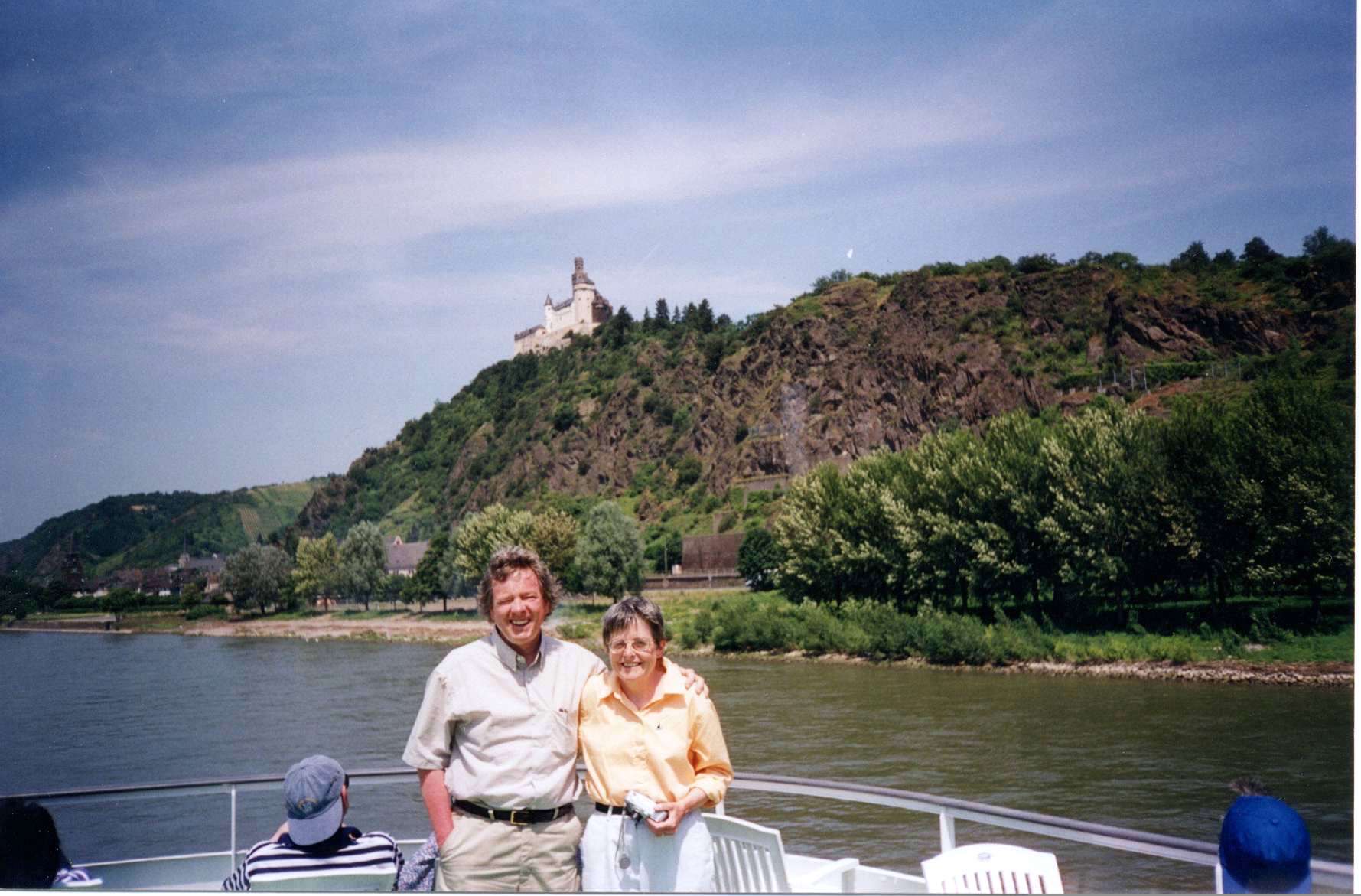
I call it the Marksburg photo, even though Marksburg, the castle on the mountain behind the two of us, is almost unnoticeable. I once mounted a section of the picture on a small magnet on our refrigerator door, as a reminder of our travels along the Rhine before they grew too distant in memory. The two of us are on the magnet, with glimpses of green water and greener trees behind us and the white walls of the castle high above us. No one who sees it can guess where we were; sometimes I almost forget. In the 17 years since the photograph was taken, my hair is no longer so curly, we both have white hair now, but I still have that shirt. Our image captures that moment—the cheeriness, the closeness, the pleasure in being who we are and where we are. None of that has changed between then and now. When I found the entire Marksburg photo again, I looked at the two of us and smiled to have the moment between us recorded so well.

It took me a while to ponder what more was in the photo, not about us but about where we were and what we were doing there. Another photo taken a little further downriver, using the telephoto feature on my camera, places the Marksburg at the center of the image, rising above a round green landscape of trees and fields, poking into a broad expanse of clear blue sky. Holding the photos side by side I struggle to unearth whatever Rhine memories I can. Soon I’m revisiting old obsessions and, unexpectedly, unveiling new interpretations.


*          *          *


I’d been writing about place on a small scale, in short essays for local radio, before our first excursion together to the Southwest. The Anasazi ruins of Mesa Verde and Chaco Canyon haunted me for years after. It altered my writing, made me focus more intently on place; it sent me to unfamiliar terrains hoping to somehow connect across time with earlier authors who’d written about such places. Before we set off to any new destination I would read travel narratives and nature memoirs set there; if something spoke to me about the locale while we were there, I longed to write about it. Research projects I proposed to my university became essentially, if not overtly, about time and timelessness in place—if I went to where a writer had recorded an immersion in place, I wondered, what would I encounter there that that writer encountered? What would have changed beyond recognition? What was timebound, what timeless? Travels to Thoreau’s Walden Pond and E. B. White’s Belgrade Lakes took on the character of pilgrimages; other locations—London, Paris, Rome—seemed like nice places to visit but I didn’t want to write about them.

And then I chanced upon George William Curtis’s Lotus-Eating: A Summer Book. It opens with two chapters comparing the Hudson and the Rhine before visiting tourist sites in New York and New England. Somehow I began tracking down nineteenth-century writers who had written anything about either of those rivers, or better yet, compared them: James Fenimore Cooper, Victor Hugo, Washington Irving, Caroline Kirkland, Harriet Martineau, Herman Melville, Catherine Sedgwick, Bayard Taylor, Mark Twain, Nathaniel Parker Willis, William Wordsworth, among others. I also read travel guides and memoirs by my contemporaries. The literary scholar in me might well have launched himself into an academic monograph about the literature of the Hudson and the Rhine if the travel memoirist in me hadn’t insisted he had to see the rivers for himself—needed to stand where earlier writers stood, walk where they walked, sail past the landscapes they viewed.

My eventual sabbatical project centered on time and timelessness by following the Rhine River from its origins in the Alps through Switzerland, Germany, and the Netherlands to its dispersal into the North Sea. I would view its landmarks, its landscape, its most significant features, take in its cathedrals and castles and spas, tour sites of literature and art and history. And I would cruise the Rhine.

Even today, nearly two decades after that cruise, one of my bookshelves is still filled with books I read about the Hudson and the Rhine in preparation for my travels and in anticipation of the book I would write. My daily logbook and my project journal are on the same shelf. In an envelope in a file box in the study closet are ninety-four photos from the Rhine journey, thirty-six of them taken on that cruise. Years ago I typed up the log and journal entries and occasionally transferred the files from computer to laptop to CD to flashdrive in unreflective anticipation of—eventually—composing that travel book.

And now, after reading, rereading, and yet again rereading the entries, after leafing through the images, all lacking identifying notes, I hope at least to say more about that Marksburg photo, the cropped image still on our refrigerator door reminding me daily to go back upstairs and revisit the Rhine.


*          *          *


I take photographs in hopes of later spiking bursts of memory. Often I record trailhead signs before sites along the trail, expecting to march from one location to the next by viewing an internal slideshow of snapshots in the order I took them. If I review the images not long after the physical event, I can more vividly imbed the experience in memory. The longer the gap between being in that place and contemplating the piecemeal record on film, the more difficult it becomes to make the connection.

And so when I isolate the Rhine cruise images from the pile of photographs, I have little certainty about what they record. I handle them carefully, confident that they are arranged in the order they were taken as we sailed from Mainz to Koblenz and aware that, if I dropped them, I’d be unlikely to find the correct sequence again. Only the river in the foreground of most shots confirms that they were taken from the Köln-Dusseldorfer Line cruiseship where we sat on the uppermost deck, at the bow of the vessel, in warm sun and light wind. Other passengers surrounded us, a continual hubbub, many crowding the rail taking pictures. My images mostly center on aspects of landscape between the blue of the June sky and the blue-green of the river. I hold up one early photo and scan the buildings lining the shore—some likely domestic, some probably industrial, a pair of church towers off to one side, a dark spiked dome off to the other. Nothing in the picture reveals why I took it. All the images record what we were passing, but I’m uncertain about what they record.

I examine the photographs one at a time. They often highlight castles on hillsides or against the skyline—surely the reason for taking them. I don’t recall if anyone narrated the cruise, calling attention to specific ruins or renovations or identifying the waterfronts where we frequently docked to gather more passengers. My log reminds me that each time we departed, the ship’s loudspeakers played the opening of Schumann’s 3rd Symphony, the “Rhenish,” reminding us all that we were sailing out onto the “Romantic Rhine.” I’d played it often at home, along with Smetana’s Die Moldau, evocative river music. The memory makes me briefly optimistic that playing the recording again might spark more memories.

Attempting a more systematic, more academic approach, I compare the names of locations recorded in my logbook with locations on a map of the Middle Rhine and search through a compendious Rhine book and Wikipedia sites. By comparing a picture of my own with images in the book or on my computer screen, I slowly learn what I photographed. I record names and locations on the back of each picture and list the sites in the order we passed them on the river. I tinker with Google maps on my laptop to gain a better appreciation of the course of the Rhine, its twists and turns, its bends and straightaways, expanding my sense of where each site is located along the river.

I’d wondered what was timebound and what was timeless along the Rhine. Photo after photo captured a distant view of castle ruins or a castle converted to hotel and restaurant, castles perched on hillsides, castles dominating the summits above the river: Ehrenfels, Rheinstein, Reichenstein, Sooneck, Fürstenberg, Pfalzgrafenstein (this one on an island), Gutenfels, Rheinfels, Katz, Marksburg, Stolzenfels—still standing after five hundred, seven hundred, a thousand years, each a persistent presence along the Rhine. Two of my photos show a dark rocky promontory dominating a bend in the river, the Loreley, site of literary legend; a little further on, a bronze statue of the nude siren herself sits on a narrow strip of land extending into the river. The statue in my photo of the site is so remote and small that at first I didn’t realize it was what the picture centered on. Once I identify both promontory and statue, I remember that beyond the scope of our cruise, further north, we visited the Drachenfels (Dragon’s Rock) in the Siebenbirge (Seven Mountains), the supposed site of Siegfried’s battle with a dragon in the medieval epic Das Nibelungenlied; music from Wagner’s Ring of the Nibelung opera cycle would greet us there just as Schumann’s Rhenish repeatedly celebrated our being on the Rhine. My photos capture nothing of the artistic history that abounds here, and I recall no observations by any of those nineteenth-century writers I’d read.

Somehow I’d remembered that it was the Marksburg Castle behind us in the distance in that photo of the two of us and I was pleased with myself when I recognized it in a photo of its own. Unlike so many other castles and castle ruins, it doesn’t blend in with the scenery but dominates the hillside and the river, bright white against green woods and terraces. In its 900 year history it was never attacked, never embattled, continually restored and remodeled. The little research I do concerning it makes me think of it as merely picturesque, a fine element for the backdrop of a tourist picture.

*          *          *


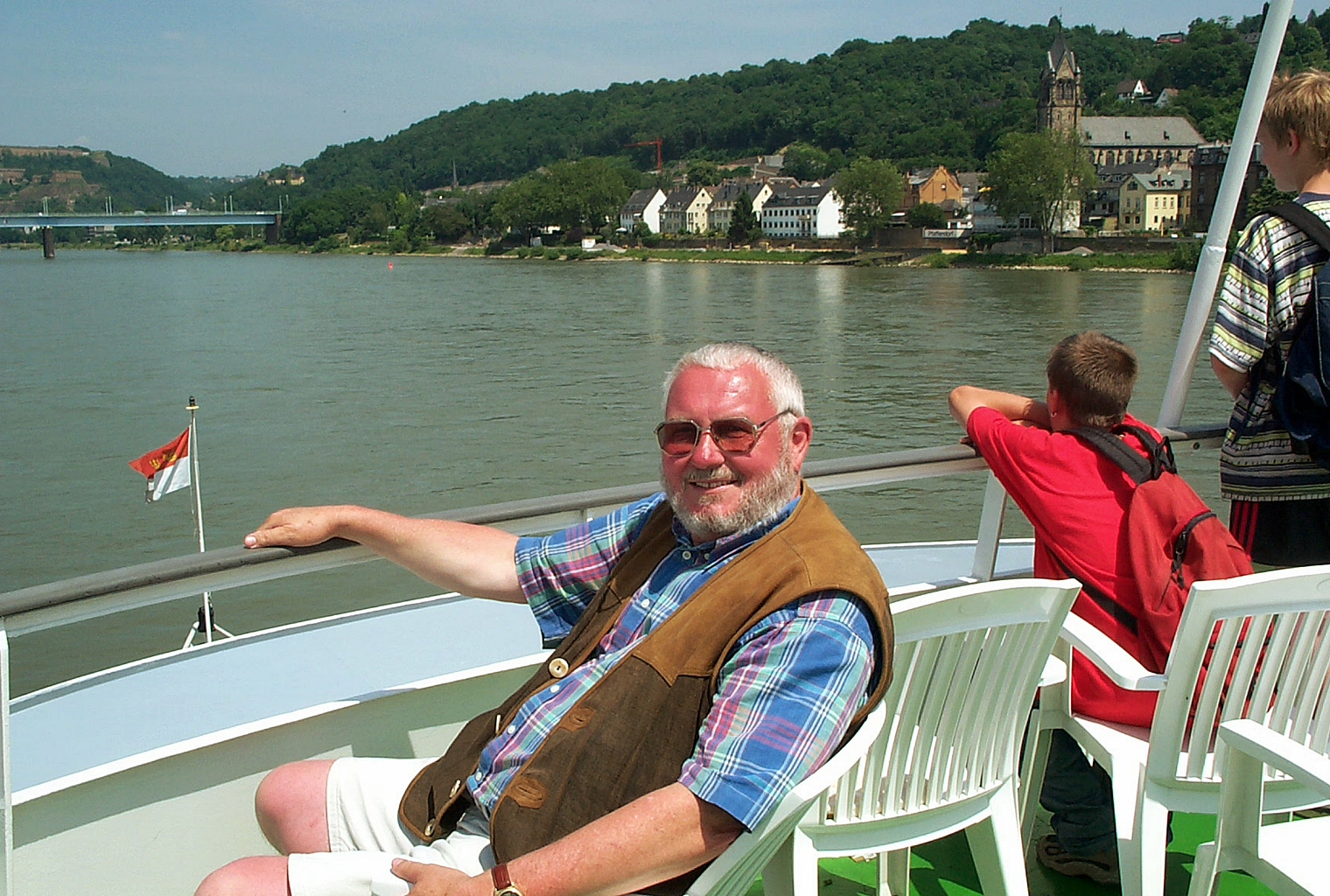
The photo of Marksburg is the kind of picture I usually take, informative, impersonal, a static record of a moment in place. The photo of Sue and me was taken by another passenger, a German with whom we’d been conversing about the Rhine. He said that we could see signs of historic high water where narrower sections of the river are wedged in by mountain ranges; he pointed out how the first floors of buildings along the river had small round windows and lower story garages and sheds in preparation for flooding; he thought Bacharach was the prettiest Rhine town, with Oberwessel second, Boppard third. We learned he’d begun learning English as a boy, taught by American soldiers occupying his hometown after the war. They would give him snack food, candy and gum sent to them from the United States, and they would teach him American expressions. They were kind to him, he said, and often funny; he liked Americans. I photographed him sitting in the plastic chair on the foredeck, the Rhine immediately behind him, the shoreline in the distance, in part because I didn’t want to forget him and in part because what he said about his childhood began altering my perception of where we were.


The cheerful, sun-burned German smiling at us in the photograph must have been a few years older than me. His conversation, light and pleasant though it was, triggered in me a growing awareness that what we were seeing along the Rhine and what we would end up seeing throughout Germany were remnants of a very different century than all those travel narratives and memoirs I’d read had encouraged me to imagine. Two World Wars were centered here—massive destruction, massive annihilation, grim and terrible aspects of life that neither my wife nor I had experienced. Later I would sometimes wonder if one of the GIs so kind to that German boy had been my father-in-law—he had served throughout the course of the war, from North Africa and Italy through the Normandy D-Day landing and the Battle of the Bulge and the liberation of Bergen-Belsen, experiences that haunted him for fifty years, to the end of his life. The German had not only childhood memories of the war but also those of the second half of the 20th Century—the rebuilding of West Germany; the Soviet occupation of East Germany; decades of political disruption before the reunification of the country he was born into. I know almost nothing about him or his life, except that he was genial and conversational and remembered with fondness experiencing the kindness of American soldiers, learning the rudiments of the English language as they spoke it, feeling safe in the midst of occupying troops. What did the artifacts of die Mittel Rhein mean to him, all those castles and cathedrals and villages and vineyards? What did he think of the foreign tourists—American, Indian, Asian, Middle Eastern—idly curious about the scenery, casually taking pictures of his homeland? Did he share our sense of easy accommodation, our sense of security, our sense of privilege?

And what did meeting him mean to me? In the days that followed I became more conscious of what was missing and what had been reconstructed and what the generation after the war tried to replicate exactly, as if the war had never happened here. In the souvenir stands the postcards of the magnificent cathedrals or the historic castles celebrated their glories but always shared space with those that recorded the demolition and destruction during the war. It was as if the population refused to forget, refused to allow themselves psychic space to dwell simply on the present, and as a consequence we cheerful tourists were constantly reminded of what came before and had to look aside if we hoped to avoid being reminded. And I would think of the wartime stories my father-in-law sometimes told his children and the wartime stories my own father, veteran of Saipan and Iwo Jima, refused to tell any of us. As we continued our wanderings I often struggled to keep focused on the sites those nineteenth-century writers recorded seeing, keep wondering how much I could appreciate the way the Rhine reminded them of the Hudson or how much being where they had been would make me feel as if I were with them then instead being here now. Given all that had happened here, was anything timeless really left? The river kept flowing, rising and falling in the sequence of seasons, and the Taunus Range on the right bank and the Hunsrück Range on the left bank still hemmed it in. But what did those castles and cathedrals and fortresses, those ruins and remnants and restorations, mean to the people who still had lives to live in the terrain around them? They were doing their best to live as much in the moment as they could, occupy their own span of time, neither timebound nor timeless, simply immediately present.

I don’t remember now if we asked the German to take our picture or if he volunteered of his own accord. Looking now at the picture he took I realize that he chose to include the Marksburg, lined the American couple on the cruiseship up with the castle on the mountain. A courtesy, a gift, connecting two visitors with a landmark of his country. I want to think it’s what he intended. Otherwise, only the moments frozen in the photographs tell us anything about where we were and how we felt about being there. Timebound images. Good ones to have.

She’s Still Young, I Am Old Enough ~ Matthew Gavin Frank

The lights in here are too bright, and they too brightly brighten the blue dish detergent, the deodorant that apparently makes one smell like a meadow in springtime, the two-for-one apples-and-cinnamon instant oatmeal, the sprigs of fresh parsley, jar of prepared horseradish, seven McIntosh apples, bag of walnut halves, the on-sale honey, the twelve eggs, the taupe pantyhose. It’s humid in this Jewel-Osco supermarket—the air-conditioning must be on the fritz— and the white tile floor, branching away from the produce section into tentacular aisles, is slick.  It’s raining again outside, but it’s a warmer rain, and twice, on the way here, my mother panicking at the wheel, we hydroplaned.  She’s still young and healthy.  She still has the four moles on her face, one clinging as if some amber invading moon at the inside corner of her left eye.

Now, she pushes me in the shopping wagon—she’s still strong enough to push me, and I’m still small enough to be pushed— and my legs dangle, kick back and forth, and the dish soap, in its plastic urn, churns itself foamy as we bounce over the seams in the slick tile.  It must be April, because the Jewel-Osco has set up a small section, at the abutment where the pet food aisle meets the soft drinks, for Passover items.  The wagon stops here.  My mom’s hands are still steady as she chooses three cellophane-wrapped boxes of egg matzo, a box of matzo meal, four bottles of kosher Concord grape juice, the chocolate-dipped macaroons.  She stacks these items amid the detergent, the parsley, the pantyhose.  My legs dangle.  Someone in an orange smock stocks soda cans.  A few aisles away, glass breaks, and my heart leaps at the sound.  Someone in an orange smock speed-walks with a mop.  A fresh emergency.

A tall man in a nice white shirt pulls his wagon next to ours.  His top button is buttoned, and his collar squeezes his neck.  His glasses are golden and they slip down his nose because he is sweating.  He has small hands, I notice, for such a tall man.  Clean fingernails.  Light hair on his knuckles.  A watch with a beige band. He is bald, or he isn’t.  He steps close behind my mom as she reaches for the box of orange and lemon jelly fruit slices.  He is too close to her, I notice.  His belt is thick and plain and the color of cream.  His mouth doesn’t seem particularly twisted or cruel, and his voice seems strangely soft—gentle even— as he bends toward my mom’s ear and says, “Just what we need: more of these kike things.”

My mom is young and healthy, but she looks old and sick.  I haven’t seen her face bunch like this before, as if she’s taken a medicine ball to the belly.  I haven’t yet heard this word before, but I feel as if I’ve known it forever.  It’s been inside me this whole time—some strange inheritance like a predisposition for heart disease.  I know what it means. My mom’s face tells me so.  Our groceries do.  She puts the jellies into the wagon.  She takes hold of my dangling right shoe.  She freezes me.  She says, “Drop dead.”  That’s all she says, all she can muster there, and she knows it’s insufficient as she pushes us away toward the even brighter open expanse before the registers.

In the parking lot, she lifts me from the wagon more curtly than usual, plops me into the back seat.  I am old enough to buckle my own seatbelt.  She fits the paper bags into the trunk, and I can hear them crinkle.  I watch the rain race other rain down the windowpane. Her hair is wet when she gets into the driver’s seat, hanging in strings around her face.  She puts the car into reverse, and turns to back out.  She is frowning, and she sees me watching the rain.  She shifts back into park. She touches my knee.  I begin nodding even before she says it, though I’m not quite sure why.  “I’m sorry,” she says.  We back out of there.

Later, she’ll tell this story at the Seder table, and she will tell it in a way that will allow the neighbors to think that she was proud of herself for her response to this man, that she really showed him.  But I was there, and I know the truth, and my father will diffuse the situation, in typical fashion, with the z’roah—the bare lamb bone meant to symbolize the paschal lamb who was sacrificed mere hours before the ancient Jews’ exodus from Egypt—taking it from the Seder plate and dancing around the table with it between his legs.  The kids at the kids’ table will love this, and many of the adults will love this too, and my mom will muster a smile, but she will sleep poorly that night, and so will my father, and so will I, and I will wake a little older, and the next day, a little older than that, and it will always seem to be raining.  In so many bathroom mirrors—mileposts, themselves, of a life—I will see, more and more, a collection of things.  Just what we need.  Cheeks that purple.  Eyes that see apples neatly stacked.  Just what we need. Mouths that dry before pronouncing inappropriate apologies.

Cris Mazza

Cris Mazza’s new novel, Yet to Come, will be from BlazeVox Books. Mazza has eighteen other titles of fiction and literary nonfiction including Charlatan: New and Selected Stories, chronicling twenty years of short-fiction publications; Something Wrong With Her, a real-time memoir; her first novel How to Leave a Country, which won the PEN/Nelson Algren Award for book-length fiction; and the critically acclaimed Is It Sexual Harassment Yet? She is a native of Southern California and is a professor in and director of the Program for Writers at the University of Illinois at Chicago.  

Caroline Sutton

Caroline Sutton’s essay collection, Don’t Mind Me, I Just Died, was published by Montemayor Press in 2017; her memoir, Mainlining, will appear in the fall, 2019.  She is a frequent contributor to Ascent.  Her work has also appeared in KROnline, Gulf Coast, The Literary Review, North American Review, The Pinch, Cimarron Review, Pembroke Magazine, and Southwest Review, among others. In 2012 she received Southern Humanities Review’s Theodore Christian Hoepfner Award for nonfiction.  Sutton is working on a new collection of essays focused on the natural world.  She teaches creative nonfiction to high school students in New York.

Grace Bauer

Grace Bauer’s most recent book of poems is MEAN/TIME, (University of New Mexico Press, 2017) and a co-edited anthology, Nasty Women Poets: An Unapologetic Anthology of Subversive Verse (Lost Horse Press).  Other books include: The Women At The Well, Nowhere All At Once, Beholding Eye, and Retreats & Recognitions. Her poems, essays, and stories have appeared widely in anthologies and journals. She teaches in the Creative Writing Program at the University of Nebraska-Lincoln, where she was recently named the Aaron Douglas Professor of English and Creative Writing.

Ordinary Time ~ Sarah M. Wells

The marketing agency I work at is meeting with a local business owner in this small but increasingly optimistic Rust Belt town. We talk about packaging. They make corrugated boxes. We say we’re here to help them dream bigger dreams, but mostly they’re looking for a shinier website and a way to get a call from some new customers. The meeting runs pretty much to script—what does success look like? Who is the hero of your story? What is the process for doing business with you? What is the call to action?

I want to show them how the folding cardboard box they manufacture is printed with artwork designed to tell how the medicine inside will help soothe the frantic mother’s newborn son’s fever so they can both sleep tonight and skip the unnecessary emergency room visit.

See how much this box matters? What you do matters so much! That’s nice, these stories, but they really want to know the ROI. How’s my SEO? What’s the CTR? How much time and money is it going to take?

In the course of six months, I’ve worked with four different packaging companies, all within an easy drive of my office, all of which do things just a little bit differently. They aren’t competitors. They manufacture corrugated boxes and display cases and windowed packages. We talk about polybags, shrink film, and bubble wrap. We talk about Contact Us forms and product menus. We talk about assembly lines and shipping and why they are the superior corrugated box manufacturer in the Midwest.

I set my limit at five of these sorts of meetings a week because they take so much time. Sometimes that’s what we hit and other times there are fewer.

Everything made had to be made.

*

This is an ordinary time in my life. In the liturgical calendar, Ordinary Time stretches long between the last days of Eastertide until the start of Advent. It’s the season in which nothing much happens. Jesus just walks around and teaches his disciples, heals a few people, holds a few dinners for sinners and tax collectors. The Israelites just wander around a while in a desert eating something fluffy and trusting God will make a more dramatic move, again, perhaps tomorrow, perhaps next year, maybe someday forty years from now.

I work forty hours a week writing marketing plans and leading strategy sessions for local business owners. We start off with a Monday team meeting in which we pray for friends and customers, share something positive, and give an update on the week ahead. On Wednesdays we have lead team and sometimes a team lunch with whoever’s available.

In the wrap-around, my children rise and obey their teachers, mostly. My husband and I are past the days of babies being born, still five years from our oldest leaving the house. We feed them breakfast and dinner and pay for their school lunches. After work, my husband and I walk the same loop every evening so the dog will poop in the unoccupied grassy space between the road and the soccer field. Tonight we might drink bourbon instead of wine, watch Friends instead of The Office.

I turn 40 in three years and my husband is 42. We’re at the middlest middle of our middle-income, Midwest life.

*

One of our clients owns a number of nursing homes—or to be more politically correct, senior living communities. The primary target audience is the son or daughter, usually the daughter, tasked with finding a solution for an elderly parent, the parent who is normally stubborn and unwilling to consider the need for a change. During our kickoff meeting, I bring up the constant strain, the dread of something happening, the guilt of failing your parent, the need for necessities to be met so you can enjoy the time you have left with them.

On the way to work, my mom and I talk on the phone about her mom. My mom is the primary target audience for this customer of mine. We run laps around the same impossible solution to the problem of an elderly parent living alone. We talk on the phone nearly every morning on the way to work. It’s a short commute, but we cover a lot of distance—all the doctor’s appointments, Dad’s latest thoughts about retirement, plans for traveling, her own precarious health and all the mundane details of my life, my relationship with my husband, what’s new with my kids.

While I keep trudging along in Ordinary Time, my mom is living in Lent, or maybe Holy Week, maybe even Maundy Thursday. She is living each day in the shadow of her terminal illness. Every moment is lined with this reality: Death has already called ahead and made his reservation.

*

Living in a small town, I often interact with clients who are also friends, who also attend church with my family, who also listen with us to live bands at the local brewery on Friday night. One such friend comes in with a hospice care provider for a kickoff meeting. Even hospice has competitors edging in for business, and business is usually good when it comes to death. Someone is always dying, am I right? I try to take a more humorous approach and know even as I laugh that this is not going to fly. I send the brief marketing video to my friend anyway, knowing she’ll laugh, knowing she wishes we could make death a laughing matter.

In our meeting with the local hospice care provider I think about my mother. I think about the numbered days until her body loses its fight against the rebel cells it made in her kidneys and lungs and lymph nodes. And because it’s 2 in the afternoon in the large meeting room and I am not alone in the middle of the night awake with my worst fears, I think about what it would be good to see in my Facebook feed if today was the day the doctor recommended hospice care. What would I need to know? What would I need to hear? I jot down what we write on the whiteboard and nod as we discuss the best digital solutions for marketing end-of-life care.

I think about death almost every day these days. I’d prefer not to, but it doesn’t seem to want to give up its grip. There are times when I drive that my mind will flash, imagine what might happen if I just let go of the steering wheel, what would happen when my car strikes against the guard rail. Sometimes when we’re walking on the sidewalk and my son is riding his bike I picture his balance wobbling, him falling wrong and into the road and into the path of a speeding car, and I blink and panic and push away the way ordinary can become extraordinary in a hot second, just like that, just like that and everything I’ve written off as typical and mundane becomes scarce and precious and gone.

*

But for now, it is still my Ordinary Time.

Tonight, my boys are battling in a virtual world against some coded enemies they probably generated themselves, stacking technological blocks toward a career that probably doesn’t even exist yet. I grow weary of the real-world battles in which I’m the enemy who limits screen time and hides the devices so they have to actually interact with me and the wild life we’ve given them here, tucked between a quiet college campus and a sharp sloping hillside where trees tumble toward a creek, muting the chaos of the engineered world.

“Go outside!” I screech.

When we finally wrest the iPods and iPads and Kindles from our youngest’s hands, he crouches low to the earth and whispers to the toads and garter snakes in all of that wildness until they come to him from under the leaves. He collects what he finds in an aluminum tub someone must have made somewhere in a factory.

We haven’t yet worked with an aluminum tub manufacturer. Besides the box guys, there are custom tool people, screw people (so many innuendos), pump people, control panel people, and people who make things whose application it takes us months to understand. They make widgedidgedoos that can be used for a whole host of things! Everyone needs a thingamajig in their whatsitdo. I bet you didn’t even know it.

When the aluminum tub manufacturer comes in, I will listen to their stories. I will learn how these tubs are the most durable and solid, multi-purpose tubs you can find. But what they will not know yet is how especially good aluminum tubs can be for toad habitats made by eight-year-olds.

Our youngest son is dragging his aluminum tub toad habitat through the backyard right now, whining about having to let the toads go. It is night, the end to yet another day.

*

Sometimes at night I catch the sunset through the pines in the valley below our home before the next episode of The Office begins. Its bright notes rise orange and red until the green of the trees is made black. It is getting dark and now that I’ve gotten the boys to go out I worry they won’t come back.

“It’s time to come in!” I screech.

Go outside, come back in, eat your dinner faster, why are you chewing like you’re in a race? You never tell us anything. Would you three stop talking so much? Stop having fun! Why are you so serious? These are our daily efforts to manipulate time and our children to behave the way we expect them to. They need to grow up someday, so they can arrive for their ride on the carrousel, so they can be prepared… for what? This?

If I opened the windows tonight, I would hear the choir of crickets and frogs, the birds finding their final evening song, maybe even the owl known to nest between our house and the next might call, if I listen.

When I put the days and weeks underneath a microscope, the way my youngest studies the earth for movement in the fallen leaves, I find filaments growing, weaving, braiding, strengthening, becoming something of greater substance. If I listen, the days and weeks stop being so same, so monotonous with their Monday morning meetings and Wednesday morning yoga practice, Thursday afternoon kickoff session, Friday night pizza. This is the schedule, the framework for the day, not the substance of the thing. If I listen, I find life.

*

So much is held together, tenuous. Death for my mom, while having placed its call, is still some distance away, staved off by modern medicine. As long as grief isn’t suddenly forced upon us, knocking the wind from our guts and robbing something precious from us, we straddle the length of time right smack dab in the middle, between Advent and Lent, trudging along in Ordinary Time.

Death is distant for us, the way all of the big unknowns for my husband and I are cemented in the past, the college and career and spouse and children choices, the hometown and relocation choices, all made already and resolved, so that there’s so much time for us to fill with marketing work and swim practice and morning exercise and episodes of The Office. At almost-40 and just-over-40, we’re at the middlest middle.

Forty is a number of substance for Biblical scholars. It’s a number that means preparation. Any time it appears in Scripture you can bet that something’s happening. Forty years of wilderness for the Israelites before entering the Promised Land. Forty days of wilderness for Jesus before his encounter with the Devil. Forty days following the resurrection of Christ to prepare the disciples for ministry. At almost-40 and just-over-40, we’re at the mid-life point commonly labeled “crisis.”

But these aren’t days of crisis. They are days of preparation. There’s so much ordinary time to fill it feels a little full, a little empty, a little bit like wandering about, a little bit without a purpose. Shouldn’t something be happening?

But isn’t it all happening? Isn’t everyone doing something to make something else happen, to make something into something else, to connect this need to this solution, to help to heal to comfort to care to love? We are gathering in conference rooms to bridge the gap between the hero and the guide, the need and the solution, the pain point and the remedy. We are gathering in rooms to connect with other humans in this small town where we’ll run into each other at the bar, at church, at baby showers, at someone else’s calling hours, and we’ll be present in their Advent, and we’ll be present in their Lent.

It’s all this Ordinary Time that allows the bones to grow, because it takes rest, you know? It takes time and stillness, habit, a solid night’s sleep for all the neurons to rewire and restore and recycle the day’s memories. When nothing tragic or ecstatic is happening there’s a lot of time spent remembering. There’s a lot of time spent making meals and taking walks and taking steps that inch you ever closer, prepare you ever so slightly more for the call, the trip, the fall, the shift, the whirling frenzy, the sudden holy slip into silence, the rising.

You won’t need to remember each sunrise or sunset, every Monday morning meeting, the variations in sun salutation routines your Yoga instructor has led you through these past nine months of regular practice, but isn’t the way you breathe different now, isn’t it good, how someone Monday will pray, someone will praise, someone will be grateful. Isn’t it lovely the way the pine trees looked last night against the red of the sky, the wispy way the smoke from a neighbor’s fire weaved its way into the atmosphere and disappeared, the way wood morphs into flame and ash into dust, the way the flicker hypnotizes and stirs, the way we were moved, if only this one small inch closer?

Allan Savory: Zimbabwe ~ Gretel Ehrlich

The moon shone on stacked thatching grass and a hyena cried. It was May and I’d returned to Dibangombe. Allan greeted me with his usual laughter and sardonic quips, and we drank tea around the campfire. Out of the blue he recounted the night long ago at a camp with a friend around just such a fire when a lion jumped in, grabbed his friend by the neck and dragged him away.

Allan used the story to inform me that things in Zimbabwe have gotten much worse than the last time I was there a year earlier. People were truly hungry and almost half the staff at the Africa Centre staff had died of AIDS. People were cutting down the trees that lined the road for firewood. Everyone cooked outside. Livestock in the villages was still allowed to run loose, elephants marauded through gardens, and the village land was predictably bare. The land resettlement program had become dangerous and chaotic: Mugabe’s cronies were being given land as rewards for loyalty, and they were finding life in the bush much harder than war. Allan saw it as an opportunity to teach holistic land management, and also to stop the poaching that had become rampant. The people who had been given land needed meat—they had nothing else—but Allan had a plan: “In the Mao-Mao wars we learned to turn our enemies into allies. Following suit, he hired a well-known poacher to become an anti-poacher at Dibangombe and keep an eye out for others killing animals.

I kept returning to Africa because Allan was part of the threadwork that held me to the life of the soil, the operations of photosynthesis, and healed land, as well as to the depredations of the global landscape. I loved being with him on his native ground, and what better place to see firsthand how degraded and desertified land could be being restored. 

 A piebald kingfisher flew up and down the stream by our tents looking for fish. “Everyone is hungry,” Allan said, watching the bird. Except here where we grow our own food. Zimbabwe was experiencing a terrible dry spell. 

After breakfast the first morning, I went with Allan and Matanga to see the large communal garden that had recently been started. “Five of the villages are now competing to see who can grow the most food,” he said. “And that’s good. In the process they are learning about harvesting water, making compost, and saving seeds. Together they are coming to see that nature’s intelligence is much vaster, more diverse, and complex than ours,” Matanga said. 

In other villages things were bad. Mrs. Ncube said, “This has been a hard season. No water to make a garden. No garden at all. And we have only one borehole for the village. We can’t buy any mealie meal (corn), so we eat millet, but the birds ate most of it. I make crochet hats to sell while we wait for the rainy season to come. Some got the UN food. We didn’t because they knew we were against Mugabe, so our names were taken off the list. My family is alright, but AIDS is killing many.”

At dinner I asked Elias Ncube if he would again be my translator and guide. I wanted to go back to the villages and see what life was like now. How would they deal with the rainless months ahead? Rail thin and articulate, Elias was happy to show me around. As we bumped along the dirt road, he said his father “read the weather,” could treat snakebites and other ailments. “He pounded the brown seed pod of the Umhlanziso tree into a powder, and it was given to prevent malaria. But there is no medicine for AIDS,” he said.

Clouds gathered and out on the highway, the mentally ill woman who had been living there for a year and begged in the villages for corn, had hung all her clothes on a tree and lay on her back in the bush, almost naked.  

A donkey cart galloped by beaten mercilessly by whip-yielding boys. We stopped where there’s a funeral going on. A tall, thin Catholic priest waved the censor over a coffin. “In the old days, they’d put a knife in the dead man’s hand,” Elias told me. “He’s called a ‘Suntwe’ – a hyena. That animal is associated with death. It’s also a witch’s animal. You are to make a sound like a hyena during the ceremony and the chief gravedigger makes hyena sounds to frighten the spirits away. But as the elders die, the old ways are disappearing. Now they do a Christian burial in the morning and the traditional one at night.” 

We’d stopped for a group of people passing by on foot, and now, when Elias started the engine, the chickens that had shaded up under the truck scattered. A four-up donkey cart trotted by with children in the back, singing. We stopped to give a woman a ride. She said, “There’s actual hunger here now. Some days we eat watermelon. Our corn died.”

An oxcart filled with furniture passed the other way. “Someone is moving. That means someone has died.” Elias said. “When parents die of AIDS, the children are taken to relatives. Some have many children and there’s not enough money for school fees or food. And some children are left with no extended family at all—when every adult has died of AIDs, they are put into the orphanage in Harare.”

We visited Mrs. Ncube’s village. Someone was grinding corn with a mortar and pestle. She asked how I ground my corn at home. Though I can’t grow corn because of the high elevation—-I made the motion of turning a hand grinder anyway. We looked in on an old woman lying in a hut who had a broken pelvis. There was no medical care. She was given a remedy of ground tobacco.

The land was puce and ochre and covered with rocks. We ate soup made with water, ground corn and pumpkin. A young girl knelt by me with a 19th century iron heated with bits of coal and ironed the skirt Mrs. Ncube would wear that night for a meeting in town.

It was hot. Goats and cattle wandered loose. Back at camp there was conversation about past droughts. “Down in the low velt,” Chris, one of the educators being trained by Allan, said, “Dryness can be worse than here. In the 1960’s the wart hogs stayed alive by eating the bones of dead animals. I had two horses and could barely keep them alive. At the end of each day, I’d collect buckets and pick green grass by the edge of the highway for them. When the dry lasted for two seasons, we lost 60,000 impala. The Sahalians say there’s no such thing as a one-year drought. Animals gain weight in the wet season and lose it when it gets dry. But the second year, they lose weight all year round, then die.”

Allan listened, puffing on his pipe: “You should plan every year as if it’s a drought and always keep a drought reserve. That way, if there are good years, you have a bonus!” Allan’s own rangeland had always been managed carefully. Grazing was planned; cattle were herded to new areas every two or three days, and at night, held in a portable corral tended by herders who slept around the edge to keep the lions and other predators away. The grass at Dibangombe was waist high. There was water in the rivers, fruit on the marula trees, vegetables in the communal garden. Enough food for all.

Before dusk Allan and I walked to the edge of the vleit. It was alive with guinea fowl, impala kicking their heels, pairs of baboons grooming each other, and shy kudu hiding in the bush. “When I see this, I’m happy,” Allan said.

That night the new moon stood straight up like a spear with planets top and bottom. Clouds gathered but a strong wind carried them away. The next morning, we walked with the herders and 800 head of cattle through acres and acres of waist-high grass. “I wish that people would come and see that even when there’s no rain, we still have grass and water and healthy cattle. There would be no drought if the soil was taken care of, if rain was allowed to seep in.

Later I accompanied Allan to a meeting with the Zanu-PF soldiers who had been put on land at the edge of the Africa Centre. When we drove up, everything grew tense: the men grabbed their guns and walked toward us. Barefoot and unarmed, Allan stepped out of the jeep to greet them.

They sat in the shade of a big tree and listened as Allan explained his plan. He offered them jobs as anti-poachers. They would get a uniform, a gun, shoes, meat and a salary. One or two agreed. The others sat stone-faced holding their rifles. When we left, I wondered if we’d be shot in the back, but we arrived back at camp safely.

The following day Allan had to leave for a meeting in Bulawayo and left a loaded shotgun on my cot with a note, “Use only on humans, not animals. Back tomorrow.” Lions roared all night, but no angry soldiers came down the road.

In the morning I sat by the stream and watched kudu and impala come to eat the seed from the acacia tree’s long pods. When Allan returned a bull kudu circled our camp making a barking sound. “Animals come in close at night because they usually aren’t hunted then,” Allan told me. “Elephants come to drink. Sometimes they have dripped water on me when I’ve slept by the campfire. But one night, in Mozambique, a problem elephant that had killed a railroad worker, charged me. There was a full moon and I wrapped silver paper around the end of my rifle so I could see the barrel and tracked the elephant. He came for me. It was a double barrel 470 and when you fire, two or three feet of flame comes out and blinds you for a moment, so you have to make sure you don’t miss! Fortunately, when the elephant saw me, he ran away.

“Animals know more than we do,” he said. “Once a male giraffe had been pushed out of the herd and went to live many miles away. But when the leader with the harem died, that giraffe somehow knew there was an opening for him, and he traveled a hundred miles to take over the herd.”

Later I helped feed the baby elephant Allan had adopted. Its mother had been poached and killed. She wrapped her trunk around my arm as I gave her a bottle and looked into my eyes. “Elephants are very sensitive, very nurturing. They bash through the bush, pushing down trees and eating all the fruit, but they care for each other beautifully. When they get nervous, they hold one another’s tails.”

*

The following weekend, Elias and I drove to the communal lands. I’d heard about a “rainmaker,” and I wanted to meet her. The talk about drought which isn’t only insufficient rain, but also the inability of rain to permeate the soil, had made me wonder what the traditional people thought. I wanted to know about what they called “the spirit side of weather.” I wanted to know if they could make it rain.

We drove past groups of huts scattered between large fields sectioned off with brush fences. The sun was already hot, the sky, cloudless. From out of the bush, a man appeared carrying a walking stick and a plastic briefcase. It was Mr. Ncube, who knew where to find the Rainmaker. “The spirit came to her this morning while she was walking to another village to visit,” he explained. “Now she is in trance at someone else’s home, but she said to come. Mama Mbyata is waiting for us.”

We took a little-used red dirt track. As we bumped past clusters of thatch-roofed huts, some with single solar panels, Elias said his father had three wives and one of them had the rainmaking spirit. “She’d fall down hard on the ground when it came into her, but she never got hurt. The spirit comes to them when they are children, maybe ten or eleven. They want to be by themselves a lot. Sometimes its inherited and can skip a generation…but I didn’t get it!” he said smiling.

We stopped while Mr. Ncube asked directions from someone walking the road, then started off again. He said, “The spirit comes up automatically, and the elders know what to do. They recognize the signs of a trance coming on and arrange for the drummers and prepare something to drink.”

Finally, we pulled into the village and walked to the mud hut where we’d been told we’d find her. A row of tall drums leaned against the wall and four women sitting outside told us to go in. Inside it was dark but I made out two bodies wrapped in blankets on the ground. A woman leaned against the central pillar. She told us where to sit. I looked around, confused. Were these dead bodies on the floor? Was this where the rainmaker would be?

We sat in silence for a long time. Then something moved. One hand came out from under the blanket, then the other and suddenly the rainmaker sat bolt upright. Her eyes were closed, and her body shook with spasms. Hands trembling, her chest heaved, and strange sounds came from her throat: squeaks, moans, huffing.

With her back ramrod straight, she began singing. Her eyes were open but unfocussed. Mr. Ncube sat on a three-legged stool at her feet. She mumbled something to him, and he turned to me: “She says someone from far away has come in and she welcomes you.”

A young woman was summoned by Mama Mbyata who whispered something. She rummaged around in the blankets and pulled out a hat with spike-like protuberances sticking up, a blue visor, and a cloth hanging down the back. The hat was lifted with reverence and solemnly placed it on the rainmaker’s head like a crown. Mama Mbyata hummed and chanted, then a terrible, shaking took over, and just as abruptly, stopped.

She was handed half a gourd filled with water. She wet a wildebeest’s tail in it, then drew it under her nose, inhaling. She chanted again and asked for her rattles. Another search ensued and one by one five or six were found in the blankets and put into her hands. She shook one, then cried out: “No, no no…” and threw it down. She tried another and another until she found the right one.

Four women squeezed into the tiny hut and began singing in harmony, while the rainmaker shook a large rattle to one rhythm and a smaller rattle to a different beat all the time uttering staccato moans. “They are bringing up the spirit,” Elias whispered. The bundle at my feet moved and a bare-chested woman pushed blankets away and sat up, her shoulders shaking as from a fever. The gourd rattles’ syncopated rhythms grew louder. Mama Mbayata’s chest was thrust forward; her face was blank. She mumbled an instruction to the villagers to bless their garden seeds, then lay flat and motionless for a long time.

When she sat up again, she said she’d had a dream: that the children would get sick and have terrible headaches as if their heads had split open and they’d foam at the mouth. The elders must take them to the borehole and tie sedge plants to the children’s hands.

Elias leaned forward and spoke to the Rainmaker. He told her I’d been hit by lightning and certain powers had revealed themselves to me, that I wanted to know how to use them.

She asked me to sit facing her. I kneeled and she held my hands. She said there were obstructions that had to be removed first. She drew the wildebeest tail through the water in the gourd and after, pulled my hands along the length of the wet tail, then held it to her nose. I was pushed closer and she wiped the tail across my forehead and hers, then rubbed her forehead hard against mine—back and forth, back and forth.

I was wearing a loose cotton shirt and she wetted my chest with the tail, leaned in and licked my skin. She asked me to wash my hands in a small bowl of water and I did and after she raised the bowl with two hands above her head like a chalice and drank down the dirty water. She said there was an obstruction and I must wash myself in the river to cleanse myself. I must make amends with my parents, she said. Mr Ncube assured her that he would see that I did. There was a long silence. Mr. Ncube leaned toward me and said quietly, “It’s over now. You can thank her and go out the door.”

I looked back before leaving: Mama Mbyata was lying on her back, eyes open but unseeing. One of the helpers crouched by her and wiped sweat from her face and chest. We walked from the hut and I stopped once to look back. The dry shushing of rattles rose up with the harmonies of the four women singing, and the low animal groans of the Rainmaker lying in trance later merged with the beating of drums in a tight circle around her as the whole of Zimbabwe waited for rain.