A Gift of Parts ~ Michael Pearce


I think of the things he doesn’t know, not yet,
in his eight years. The feel of a chisel against oak,
the smell of sage in Rivas Canyon,
a winning jump shot, a love run dry,
a laugh that loses its way.

Surely the battering of years has shown me
that I’m still just like him, a leaky boat of experience
floating on an ocean of unknown stuff.
But at night when I hold him I become his ocean,
wise and powerful, smelling of the past and the future.
I squeeze up close, his shoulders against my chest,
hip against my belly, he’s my island and I’m all around him,
I comfort and overwhelm him with touch and breath
and songs that bore him to sleep.

I want to make this sea, or some of it, his,
want him to know about the payoff of slow hard work,
the small triumph of facing something that scares him,
the power in pushing the bounds of what his skinny body can do.
I want to tell him about my own epic error
that took me so far away for so long
that finding my way home was a Homeric crapshoot.

But he sees the danger in my plan
sees it faster and surer than I do,
and before I know it he’s built a stone cottage
to shelter the fragile integer of who he is.
I see him in the window sometimes,
shaking his head at my wise advice.
Every now and then he opens the door a crack,
a hand appears and grabs some shred of what I offer.

I stand out here in the night air,
dismantling who I am, where I’ve been,
leaving a heap of parts for him to pick through.
I’d give him almost anything, any bit of me
that might help him grow bigger, shine brighter—
here’s some country music and a throat to sing it;
here’s how to trade meanness for a bumbling joke.
And since I can’t tell him who or how to be,
I’ve thrown off reason,
left it there with the rest of my stuff.
And I’ve taken up prayer.

I pray he doesn’t embrace my melancholy,
or the fear that turned me away from true love,
or my little trick of shrinking people so I don’t have to grow.
I pray that, as he stumbles through a lousy week, he can find
the lust to slog on that my dad hid from me.

I peel off the pertinent pieces of me, body and soul,
drop them one by one at his doorstep,
old and worn and mostly useless,
but there waiting for him, as I do. As I get closer
to my own naked end, I catch glimpses of him,
of what he takes, of what he leaves behind.
I give, I shake, I stand my watch. He takes my tears.

Jeanpaul Ferro

There are notable people buried in Swan Point Cemetery.  Thomas Dorr of the Dorr Rebellion.  Four Congressional Medal of Honor recipients.  Aunts and uncles and cousins of Presidents, celebrities, black sheep that inhabit every family. The fathers of American horror, H.P. Lovecraft and C.M. Eddy, Jr., battle for tourist attention.  Painter Robert Henry is near them, too.  There are the six-hundred men who fell at Bull Run, at Fredericksburg, at the Battle of the Seven Pines.  An Olympic runner.  Twenty-three Rhode Island governors scattered about like stones on a beach.  The grave of Elizabeth Chace, whose Central Falls home was one of the last stops along the underground railroad.

Walking from grave to grave I saw the names of thousands of children.  Not one had made it to  seventeen.  Back in the 18th and 19th Century entire families were lost in weeks.  Consumption took five from this one family.  Six from another.  You can see they all died close together.  Eliza: 1 year; 6 months.  Thomas: 4 years; 2 months.  Edwin: 3 months; 4 days.  Row after row of names.

There are 40,000 names carved into those marble headstones.  Strangely, this Providence graveyard has become a mecca to all those haunts looking for H.P. Lovecraft’s ghost.  Many of them come on Halloween, where they stand around together smoking French cigarettes, drinking Bourbon, and making toasts like they somehow knew the guy and would have liked him, even though nobody in real life ever did.  They bought Lovecraft his own headstone once.  It reads, I am Providence.   Yet when they come here to find him, they find themselves looking at another grave, looking at a marble tomb of a lost brother and sister whose arms are wrapped around one another.  A white tomb the color of snow.

This is the grave everyone is drawn to.  Maybe the two of them hadn’t accomplished a thing in life.  Maybe they never said or wrote a word that mattered.  But years later, decades after they were gone, strangers come to mourn them.  People come from all around the world to place pebbles, copper colored pennies, bracelets, and mementos like they knew these two kids.  That morning someone left a teddy bar and placed it atop their tomb, just before the snow began to fall.  There was a trail of footprints that lead away from the grave.

Melanie Hoffert


So far, Iceland is black lava. So far, Iceland is water of all sorts: glacially tinted ocean, sulfur-soaked hot springs, and sleet-laden rain. So far, Iceland is rump-facing sheep and horses with blonde-ancient manes. And today, Iceland is a wish.

According to local lore, the spirit of a woman named Guðrún Ósvífrsdóttir’s grants three wishes to the pure of heart who circle her grave and then climb to the top of Helgafell Mountain, or “holy mountain”, without looking back or speaking a word to anybody. Guðrún was a woman who was married four times and then lived out the last part of her life as a nun in a convent she built on the top of Helgafell.

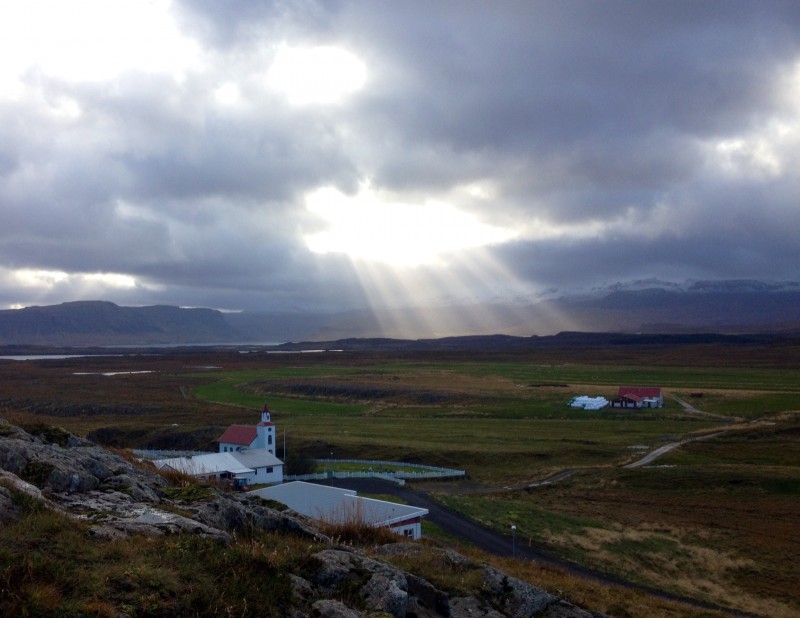
Just a few minutes ago as my friend Jessie and I rounded a corner on our way to the grave, the sky cracked open over the tiny red-roofed church where Guðrún is buried. The sky’s break, a flood of majestic light, was so otherworldly that it appeared as if the church would be sucked up in an ascension of sorts. This perfect, I thought to myself, a sign of wishes granted.

“Okay. So the book says that we circle the grave counter-clockwise. As we walk we think of three wishes. After we make our wishes we hike up the mountain without looking back or talking to anyone.” I look over at Jessie who is sitting in the driver’s seat to see if she’s tracking my instruction. She nods while pulling on her gloves. I continue, “It also says that our hearts must remain pure in order for our wishes to come true.”  We look at each other and smirk. “Doable,” I say, “right?”

Jessie is wearing all black. She’s a no-nonsense native New Yorker. Our early life experiences couldn’t have been further apart since I grew up on a farm.  Yet when we met at work several years ago, we became fast friends and endured work with sarcasm as our survival mechanism. Pure of heart is not our strongest suit when we are together.

This trip marks both Jessie and my entry into our fortieth year. And, so far, we’ve taken on Iceland as if performing an extreme sporting competition, racing to see every exterior inch of this northern island. But, now, as we push our car doors open against a blustery wind and begin our walk toward the church, I decide that I need to enter the raw interior of my soul. I want to enter into the next chapter of my life with purpose. And the wishes, though superstitious, seem like a good way for me to slow down, reflect, and fully acknowledge what I am leaving behind as I chart a path for my future.

We enter the graveyard and waste no time waking directly to an official looking grave that is framed by a white picket fence. “Three times. Counter-clockwise. Pure of heart,” we repeat our instructions in near unison, knowing that we cannot talk to each other until we come back down the mountain. Next we circle the grave, walking slowly. I bow my head into the harsh wind while I formulate my wishes. Then, without looking at each other, Jessie and I start our ascent up the mountain in silence.

The walk is slow, winding, and cold. And with each step I hold my wishes—lofty aspirations about my future—in front of me while I also review my thirties in flash-card images. While much has unfolded in the last ten years, it is the ending of a sixteen-year relationship within the last one that takes up much of my reflection. In ending the relationship, I had finally done what I thought I’d never be able to do: let go and start anew.

I hear Jessie’s steps on the earth behind me. She is a recent survivor of Leukemia. Her diagnosis had socked me in the gut. Fully recovered now, she spent seven weeks in the hospital not knowing what her fate might be. Her battle makes the ending of my relationship seem like a staccato of an inconvenience.

At the top of the mountain we have two options. We can either descend down a path in front of us, which looks like it was worn by sheep, or we can turn around and go back down the manicured trail that brought us here. Because I can’t consult Jessie, I decide to follow the narrow path ahead. After all, we can’t look back.

The way down is steep, rocky, and a tricking brook makes traversing the path messy and slippery.  At several points I have to place my hands on the ground to scoot down. I know, instinctively, that Jessie is probably swearing in her head behind me, questioning my decision. Pure of heart, Jess, I try to send her subliminal messages to remain calm.

After a tricky handful of minutes we finally near the end of the path, which brings us down to the backside of the church. As we get closer I notice a grave sitting outside of the graveyard. I pick up my pace, walk to the grave, and bend down to study the letters etched within the mossy granite. “No! Jess, this is the grave we were supposed to circle,” I say, breaking my silence.

“Unbelievable,” Jess responds, “just unbelievable.” This little mishap is for us a continuation of wrong turns, unexpected weather, and many other blips that often come with traveling.  “And, by the way, I don’t think that was the right path,” she says. “I slipped and fell at one point,” she adds.

“Oh well,” I say. “It was an adventure, at least.” Yet while I shrug it off, and we both chuckle at our luck, I feel unsettled. Perhaps Jessie had taken this lightly, but I counted on this moment to—at least symbolically—set the foundation for my next decade.

Defeated, we start back down the road to where we parked. As we walk I study the clouds. All morning they have filtered the sun like a prism.  Their beauty, their movement, lightens something within me. I glance at my friend. She is healthy, living. We are so lucky to be here, I think, in this land of sea and sky, of rock and shore. And my heart, while hurting, is healing. It is in this moment that I know that life has been, always will be, more interesting than any wish. Because it is within the unforeseen, the bittersweet, the space after pain where life is always the best, the sweetest. “Thanks, Guðrún,” I whisper and smile.
 

Kirsten Wasson

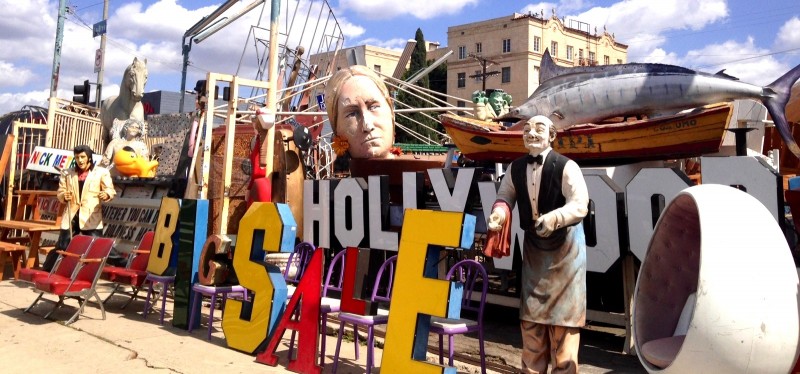
During the first few weeks after moving to L.A. for my mid-life crisis, I drove around having no idea where I was. Ever. Some days I ended up in Santa Monica where the Pacific was pounding the shore and people were surfing in wet suits in February’s miraculous 75-degree weather. Other days found me turning the curves on Mulholland Drive, the circuitous route that moves from grand wealth at one end to dark stealth at the other. One afternoon I passed the corner of La Brea and First–though I didn’t know the street names at the time—and saw what appeared to be a Fellini set with demons and angels spilling out onto the street. I parked and took a picture but did not go in. I didn’t know where I was.

A year later I drove again past this dream sequence of a place and decided to enter Nick Metropolis’ Collectibles. It was a Hollywood bombardment:  headless mannequins, leopard couches, pinball machines, glass chandeliers, dinosaur cigarette lighters, Marilyn Monroe throw pillows, mirrors with rhinestones frames. There was one mirror encircled with  medium-size animal bones. And there were letters, hundreds of letters–all colors and sizes, having come presumably from signs and billboards that once announced appearances of the famous or hoping to;  the alphabet was strewn about as if sentences in the sky had fallen and landed here in haphazard piles.

Nick M, the man himself, had made BIG SALE out of some of the letters for the front of his store, an open air house of mirrors and dreams he’s owned for twenty years. I wandered about and watched Nick, a short handsome Greek with olive skin, dyed hair, and beautiful lime green and blood red tie, negotiate with customers. I’d fallen in love with the mirror with the decorative bones and asked the price.

“One hundred and fifty. But for you, one twenty. Are you a witch?”
“Yes,” I replied for what reason I knew not.
“Well this mirror was made for the set of a show called Witches. Ever see it?”
“No. I’ll take it.”

That’s what is great about mid-life in L.A. You can pretend to be a witch or anything else in the mid-day with the sun shining, Elvis close by, surrounded by artifacts bespeaking glamour, leisure, dismemberment, domesticity, debauchery, and magic.


In a previous incarnation, Kirsten Wasson was a professor of American Literature at Ithaca College in Ithaca, New York.  Currently she makes a home of sorts in Beverly Hills where she works as a tutor, event planner, and copywriter. She has work forthcoming in LA Review of Books, and is a storyteller at many venues around L.A.

Sharon Chmielarz

Sharon Chmielarz’s latest books of poetry are Calling , a finalist in the Next Generation Indie Book Awards, 2011, and The Sky Is Great the Sky Is Blue. She’s the recipient of the 2012 Jane Kenyon Award from Water~Stone Review.  You can hear her read on www.sharonchmielarz.com