Temple of Love ~ Ted Conover
I love walking New York City.
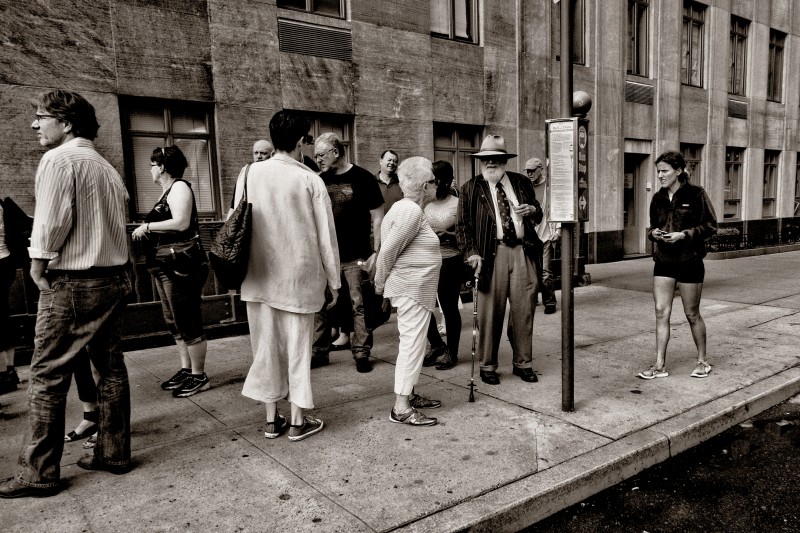
I understand street photography at last and walking New York is the diamond, is the cream at the top of a frozen bottle of fresh milk. There is movement and life everywhere. There are extraordinary moments, certainly, and there are moments, slices of living a small camera and a quick eye can snatch out of the sea of just everyday and put up on the screen for people to peer through. If the images are any good the viewer can look and say ” I know that.”
http://www.robertfischerphoto.com
Roger Leege has both BA and MA degrees in Visual Art from Goddard College, as well as post-grads in Industrial Technology (Central Connecticut State) and Computer Science (University of Hartford). He was a painter, printmaker, and analog photographer before the advent of small computers, and he was an early adopter and evangelist for digital artist’s tools. As an artist and educator, Roger has worked at the intersection of art and technology throughout his career. With gallery and publication credits in the US, Canada, and the United Kingdom, he maintains his portfolio project site at www.vianovaphoto.net and uses www.rogerleege.net for custom framing, printing, and online sales.
Sue Granzella’s essays have won awards in the Soul-Making Keats Literary Competition and in Memoirs Ink. Her writing appears (or is forthcoming) in The Citron Review, Hippocampus, Write Place at the Write Time, Rusty Nail, Lowestoft Chronicle, Prick of the Spindle, and Crunchable, among others. Sue teaches third grade in a public school in the San Francisco Bay Area. She loves baseball, stand-up comedy, road trips, hiking, and reading the writing of eight- and nine-year-olds.
I have some great pictures of my dad. There’s the one of him reading to my two sisters and me, the oldest of us only five. Jan, the eldest, is nestled against his right side, Nan is tucked under his left arm and is gripping his thigh, and I’m pressed up behind him with my arms draped over his shoulders. We are all mesmerized by the story; none of us notices the camera. Dad’s large sun-darkened hands dwarf the miniature cardboard book that he holds, and his black hair is mussed. He’s wearing a short-sleeved white shirt, unbuttoned at the neck. He looks worn. I like to imagine that he’d just gotten home from a long day at work, and we had come running to him, crying out and waving the book, begging him to read us a story. He couldn’t say no.
Then there is the set of pictures of Dad on a Reno stage with Tony Orlando and Dawn. I wasn’t there when he was called up to join the mustachioed singer of “Tie a Yellow Ribbon,” but I’d many times seen Dad show the photos to friends. In one, he’s grinning tentatively and snapping his fingers, while Tony leans up close to him, tapping out the beat and clutching a microphone. In the other two shots, Dad is laughing, probably because one of the hair-sprayed Dawn ladies has just planted a heavily lipsticked kiss on his cheek. Whenever he brought out the pictures, his brown eyes sparkled, his ruddy cheeks went apple-round, and he let go a great laugh, telling how much fun he’d had working the audience during his brief time on stage. Mr. Orlando had asked Dad his profession, and Dad had pantomimed fear and shame, whispering, “Insurance agent,” into the microphone, playing off the recent California ballot initiative that had attacked the “evil” insurance companies. The crowd had roared with laughter.
But my favorite picture of Dad might be one that I took with a cheap Instamatic. The colors have faded, and the image isn’t all that clear. He is looking straight at me from where he stands on the shores of Italy’s Lake Como, on a pilgrimage to the villages of his parents. It is his first time in Italy, and he is about to meet his aunt and his many cousins. He may have been far away from his house in Napa, but in a way, he was very close to home.
*
A few weeks prior, my dad had invited me on an all-expenses-paid, nine-day trip to Italy. This would be no typical tour of gondola-filled canals, tipping towers, and naked men of marble. It would be the two of us exploring the roots of his heritage. I’d told him no. I did say thank you. But I still said no.
The only time I’d known Dad to leave the U.S. was on a family trip to Tijuana when I was nine. We’d gone to San Diego for four days of vacation, and when we crossed into Mexico for a few hours one afternoon, Dad showed off his bargaining skills in the public markets. We came home with maracas and brightly-painted clay flower pots, and I was proud of my worldly father who knew how to shave pennies from the cost of tourist trinkets.
Now I was twenty-eight, and he wanted to see Italy. He had no desire to visit the usual tourist haunts, though. No, my dad had decided at age sixty-four that he wanted to go to the villages of each of his parents. The two hamlets were three miles apart on Lake Como, near Italy’s border with Switzerland. Many relatives still lived in each of the villages, and Dad wanted to meet them.
I’m not sure if the desire came independently from him, or if it was prompted by my mom’s decision to go to Yugoslavia, the land of her father. In a move that still mystifies me, my parents, who happily did everything together, planned to go on their respective European family-tree quests at the same time, but separately. Jan was going with my mom to Yugoslavia, and Dad invited me to go with him to Italy.
I had my reasons for saying no. I’d recently ended a four-year stint of working and living in high-poverty neighborhoods, first in Northeast Portland, and then in East Oakland. My heroes were Dorothy Day and St. Francis of Assisi, both of whom devoted themselves to lives of “voluntary poverty” and opposition to war. In my early twenties, I’d learned more about these two iconic Catholic figures, and discovered the name for what I’d always hungered to do. I wanted to work for “social justice,” a new phrase that I kept hearing in my vibrant college church community. I couldn’t wait to live closer to poor people, and to do work there that “made a difference.”
So after graduating from UC Davis, I pared my mismatched college-student possessions down to a suitcase, and signed on for a year in the Jesuit Volunteer Corps. Nine of us educated, idealistic young men and women lived in a former convent in Portland and worked with migrant farm-workers, inner-city elderly people, and free-clinic patients.
Before heading back to California at the end of the year, I put on my Birkenstocks and joined a scraggly group of sprouts-eating, drum-beating, beard-sporting peaceniks, grandiosely called the World Peacemakers. We spent a month walking 350 miles along the Columbia River, from Astoria on the Oregon coast to Pasco in eastern Washington, speaking in towns along the way about the evils of nuclear weapons and waste. Curled up in my sleeping bag in each night’s roadside rest area, I read pages from Dorothy Day’s autobiography.
Just after the peace walk, I moved into a Catholic Worker house in East Oakland. The Catholic Worker was a movement co-founded by Dorothy Day in the 1930s, and it was in that shabby East Oakland storefront building where I truly felt my life explode with purpose. My sociology degree went into a figurative file cabinet, and with five other middle-class idealists, I leapt into work with refugees and homeless people. That three-year period was a whirlwind of faces: young men fleeing El Salvador, battered women in the middle of the night, and families in need of donated furniture. I learned Spanish, demonstrated against the U.S. role in Central America, and changed sheets for homeless families. We received room and board and a thirty-dollar monthly stipend from the donor-filled cash box. We had cockroaches, no heat, and plenty of mice. The building shook every time the #82 bus rumbled by on East 14th Street. And I loved it. I’d never felt so alive. I preached to relatives during Christmas dinner at my parents’ house in Napa, saying that every day, I saw the face of God.
Dad hated that I lived in East Oakland. He’d worked for more than thirty years as a ship-fitter and then a shop supervisor at Mare Island Naval Shipyard, a job so stressful that it had weakened his heart, all so that his four kids could be educated and have choices in life. In his eyes, my choice had been to throw my education away. And he feared that by living in a high-crime area, I was taking a risk of throwing my life away, too.
I hadn’t realized how deeply seated his fear was until one morning at the Catholic Worker when the phone rang. Leaning against the battered donated desk in the kitchen, my feet flat on the three archaeological layers of worn-through flooring exposed in various spots, I answered.
The voice on the other end wasted no time. “Is this Sue Granzella?”
“Yup. Who’s this?” The man sounded very familiar, but I couldn’t place him.
“It’s Dino! What the HELL is WRONG with you?! You’re KILLING your FATHER!”
I was as stunned as I was frightened. A fellow Italian, Dino had grown up on the same county road in Napa as my Dad had, and both he and Dad had raised their families on that same road. I’d known him and his kids since I was born. Why had Dino used “killing” in the same sentence as “your father”? And he never called me. Why was he yelling at me?
I stammered out my confusion and asked, “Did something happen to Dad?”
Dino needed no prompting to continue. “Your dad read in the paper that a twenty-five-year-old woman was murdered in Oakland. He’s been terrified to call you for three days because he’s too scared to find out if it was you. He thinks you might be DEAD! Why the HELL are you living there?”
Shaken, I babbled something about how I was fine, and assured Dino that I’d phone my dad right away. But when I called Dad and told him nothing had happened to me, I knew that it was little comfort. I could almost hear the voice in his head answering, “Yeah. Not this time.”
I wanted to save the world, but Dad wanted to save me. Every few weekends, I’d hop a Greyhound from Oakland to visit my parents in Napa, and Dad would keep trying. He urged me to move away from the high-crime area, get a real job, and start investing money. Reasoning with me was not the sole method that Dad used in trying to persuade me to leave. He also practiced his own form of the nonviolent resistance that I’d learned about from reading Dorothy Day and Gandhi. When my extended family would get together near Oakland, my mom would make plans to pick me up. But Dad never got out of the car. He tolerated my mom stepping across the littered sidewalk to knock on the door, but he refused to get out, sitting behind the wheel in silent protest, never setting foot inside the dilapidated East 14th Street building that was my home.
The most dramatic statement that Dad made against what I was doing with my life was when he told me that he was writing me out of his will, explaining that he was doing so because I’d probably “just give everything to Nicaragua.” My brain’s robotic response was to think: “This should feel like a huge rejection.”
But somehow, it didn’t. I understood why he’d done it; he was being practical. Even a child knows that when it’s time for her to give away an outgrown, treasured stuffed animal, she’d rather give it to a kid who will appreciate and take good care of it. What I really felt awful about was what my mom told me afterward.
Just before Dad talked to me about the will, I’d explained to him that I didn’t want material wealth, that I’d probably never want to buy a house. The next morning, my mom told me that she and Dad had stayed up late talking, and that he’d kept repeating, with a lost look in his eyes: “She thinks how we raised her was wrong.”
I felt sick. I couldn’t stand having Dad think I didn’t appreciate all they’d done for me. I needed my parents to know that I was grateful; I just wanted to do something different. I started writing letters to the two of them, thanking them and telling them what good examples they’d been of how to care about other people. I wrote letters to my dad, telling him how much I admired his integrity, and the way that he always stood up for what was right, even when “right” wouldn’t benefit him. We were merely two branches of the same tree. I told him we were much more alike than different.
After three years at the Catholic Worker, I moved out. I was a little more grown up, a lot more burned out, and ready to find something different to do. It was at this time that my dad invited me to go with him to Italy. But it was hard to shake the habits formed over years of acting as if I really were poor. When Dad said “Italy” and “for about a week,” all I could think about was how wasteful it was to travel by air, and worse to go such a great distance for such a short time. There was a judgmental voice inside of me, and it kept reminding me that most people didn’t have the luxury of choosing whether or not to go to Italy. I accused myself of being an elitist if I were to go. I kept coming back to the word “hypocrite.” What a hypocrite I’d be, after all my work of the past four years. This is what I told myself.
So I told him no. But instead of the relief and closure I’d expected to feel after making the decision, I was troubled. My stomach felt nervous and unsettled. I started having dreams about Italy. And while awake, I found myself replaying stories I knew of Dad’s younger life, some of which he’d never admitted to us.
*
Dad had grown up in Napa, back when there were so many Italian immigrants that there was a “Little Italy” section of town. Napa wasn’t the trendy, winery-intensive locale it is today. The major crop of the region was prunes, and that’s what Dad’s family grew on their ranch. It was the late 1920s, and though Dad’s father, Pierino, had a piece of land, money was very scarce.
During these Prohibition years, Dad’s father distilled whiskey and sold homemade wine to try to make enough money to support his family. At the height of the Depression, their ranch was raided by the police, who split open the wine barrels and moonshine stills with axes, spilling out all hope of money for the family. Dad’s father was already grief-stricken over the recent death of his youngest son, a grief compounded by guilt. Unbeknownst to Pierino, the doctor had misdiagnosed his critically ill child, and when Pierino dutifully administered the prescribed castor oil remedy to four-year-old Elmer, the “medicine” instead killed the boy. Dad’s father couldn’t handle the added despair over the loss of means to support his family, and he shot himself one rainy December day while my dad, a fourth-grader, was in his two-room schoolhouse.
We grew up knowing that Dad had a brother who had died, and we knew that his father had died when Dad was a boy. But until I was around twenty, I’d believed that his father had died from pneumonia, because that’s what Dad told us. If not for Lillian, Dad’s older sister who eventually explained the truth to us, we might never have known.
As a child, I felt deeply connected to these two departed members of my Dad’s family, though they’d died thirty years before I was born. Every night as I lay in the dark before falling asleep, I prayed for them by name, “Peter” and Elmer. I missed them without understanding how I could.
And I followed the unspoken family rule about them, which was that I didn’t talk about them. My dad talked to anyone, everyone, constantly, extensively. He couldn’t enter a Napa restaurant without scanning the dining crowd for a familiar face, and he’d call out across the room to friends he’d inevitably see there. But he never talked about his father. Even as children, we could feel the bubble of pain about his father that surrounded our gregarious, loud, volatile, people-loving, opinionated, funny dad, and we stepped very carefully around the topic, so as not to pop the bubble.
But bubbles eventually pop, and despite our care, Dad’s pain was sometimes exposed to the air around us. When my siblings and I were in our twenties, my brother was in Napa one evening, and he and Dad had a minor disagreement. In a disproportionate response to the conflict, Dad started yelling at Steve, and my brother left for his friends’ house, just for some peace.
The next morning, my sisters and I all received phone calls from a frantic Dad. He’d been up for hours, calling hospitals and police and any of Steve’s friends he could locate, terrified that something horrible had happened to Steve. When my startled brother learned how panicked Dad had become, he went back to their house, and was stunned. Dad wasn’t standing at the door, shouting blame. Instead, Mom was there, telling Steve that Dad was stretched out flat on his bed, face down, in the dark, sobbing. He’d been crying out the same words, over and over: “I never had a father. I never had a father.”
No matter how careful we were, we couldn’t protect Dad from what was inside of him. Even so many years after the family deaths, it was still there.
Dad grew up surrounded by his Italian cousins, aunts, and uncles who came from Richmond and Occidental to the Napa ranch on weekends. His first language was Italian. Most of his family’s friends were other Italians who’d settled in Napa. His mother never learned more than a few English words, and Dad grew up eating the polenta and stew that she cooked on the wood-burning stove, stirring the bright yellow cornmeal with a flat wooden stick. Everything he’d lived and breathed had been Italian. Yet until he was sixty-four, he’d never talked about going to Italy.
It wasn’t until I turned down his trip offer that it occurred to me: maybe he’d stayed away all those years because he hurt, rather than because he wasn’t interested. Maybe Dad had felt that being immersed in all things Italian would pour salt into a very old, deep wound. Maybe it would bring him just too close to his father, and remind him of all that he’d lost. After all, he’d still never addressed the truth with us, his children all in our twenties, even though he knew we knew. Maybe some wounds never heal.
I replayed these stories of Dad’s younger days over and over in my mind for a few days after I told Dad no. They wouldn’t let me sleep at night, or rest inside during the day. And as I thought about the stories, I found that the judgmental voice inside me, the one that had told me why I should refuse his offer, was starting to be overpowered by a more gentle voice, one that made my heart quicken when I let it speak. It was hopeful, and happy. I started to realize that my dad had offered me a way for us to be united. I saw that I had a chance to disprove what was haunting us both, Dad’s belief that I thought how he’d raised me was wrong. He was giving me an opportunity to learn more about the Italian world that had raised him, even though it was across the globe from the Napa of his childhood. I wondered: would I always regret it if I didn’t go?
Finally, I felt a shift inside. I admitted that in my efforts to turn away from money, I’d actually done the reverse. I’d made money more important than everything else. My dad had swallowed pride, found common ground, and asked me to join him on it. And I’d said no, using my philosophies about money and economics as the sole criterion in my decision, choosing money over my connection to my father. I’d made money everything. What had I been thinking?
Once I knew what to do, I couldn’t do it quickly enough. A few Greyhound hours later, I was in my parents’ Napa family room, sitting at the dining table alongside Dad’s well-worn recliner. I started talking to the newspaper he was holding in front of him, knowing that he’d put it down if I said something interesting enough.
“So Dad – I’ve been thinking more about going to Italy. I keep thinking about how amazing it would be to see it all with you. I know that I said no, but…is it too late to say yes?”
The San Francisco Chronicle came down instantly, revealing a tissue-thin undershirt, and above it, his round face with raised eyebrows. “So, you changed your mind?” he said.
I looked for reproach or irritation in his face, but there wasn’t any. All I could see was a broad smile and bright, eager brown eyes.
Three weeks, a rushed passport, and an over-priced plane ticket later, we were on our way. It was Holy Thursday when we left, a day of great significance to Catholics like Dad and me, a day that generally would not be spent on an airplane. But we were happy to trade Communion wafers for cellophane-wrapped white-bread dinner rolls. We were going to Italy.
*
The Italian language that most people hear is “standard” Italian, an evolved form of the language originally spoken in Florence. Throughout Italy, however, distinctly different dialects are spoken from region to region. “Dialect” is what is spoken at home; “Italian” is what is taught in schools, spoken on TV, and written in newspapers. Depending on what part of the country one is in, the dialect might be nearly incomprehensible to speakers from another part. Speakers of “Italian” and “dialect” are functionally bilingual.
Since Dad was raised in California, he never learned standard Italian. He grew up with the dialect from the village of Dongo, which he’d spoken daily until his mother, who’d lived across the road from us, had died fifteen years prior. Since Dad was going to be my communication bridge, I was curious to know how much of the language he’d retained.
Dad had happily snagged every snack that the flight attendants had offered, and he was munching some cookies when I asked him, “So, Dad, do you think you’ll still be able to speak?”
He didn’t hesitate for a second and nodded, “Oh, yeah,” and continued crumbling cookies down his shirt front.
“Okay, how do you say, ‘It’s raining’ in Italian?” This would be a fair test – not the softball that, say, “dog” or “house” would be, but still something that he would have heard before.
“Aw, hell, I don’t know.” He didn’t even look at me; he seemed bored by my questions, and turned his attention back to his newspaper.
Oh, man. If he didn’t even know how to say “it’s raining,” this was going to be a long week, staring at stranger-relatives and waving our hands. I plunked my head down onto my tray table and tried to get some sleep.
When we landed bleary-eyed in Zurich, we grabbed our luggage and started looking for the train that my well-traveled Aunt Lillian had told us to find. As a traveler I was a novice – I’d still never been farther than Tijuana – but I knew that we needed Italian money. I’d tried to get Dad to exchange some dollars when we’d changed planes in New York, but he was nervous about making the connection and wouldn’t take the time. So I tried again at the Zurich airport to make him stop long enough for us to get some lire.
But Dad had waited sixty-four years to see Italy, and he wasn’t going to wait any longer. He ran through the airport. I was exhausted and ravenous after the long plane ride, but there was no stopping him. All I could do was stumble to keep up, as Dad assured me that we could get lire once we reached Dongo, the first of the two villages we’d see, the lakeside home of his mother.
I was dying for a nap, but once we were on the train, I couldn’t close my eyes to the wonder of the green fields of Switzerland zipping by, each fairy-tale farmhouse with its firewood neatly stacked outside. Once in a while I’d peek at Dad, expecting to find him nodding off, lulled to sleep by the rocking of the train. After all, the man could sleep anywhere. I had a photo back home of Dad, flat on his back on the off-limits grass at Magic Mountain’s amusement park, snoring away. A roller coaster was just behind him.
But his dark brown eyes were wide open now, with an expression that was new to me. My father looked like a child. He was quiet, staring out the window with his mouth slightly open, his wide-eyed gaze soaking in every detail of this new world outside the train window. It was the world that his mother and father had touched long before. Now he was touching it, too.
Finally we crossed the Italian border, and the train deposited us in the city of Como. We were so focused on finding the boat that would carry us to Dongo, we paid no attention to the sights and sounds of the city. All we cared about was finding a cab that could bring us to the dock. After Dad stopped to ask a few passers-by, we grabbed a taxi that brought us to the lakefront, where we were to catch our fourth and final mode of transportation on this journey, a boat. Jumping from the cab, my dad rushed across the street to the dock and a blue and white aliscafo, the hydrofoil vessel that would take an hour to speed us across the large lake towards our destination.
By now, I was starving. I hadn’t wanted to eat breakfast when it had been served late on the flight, because my body knew it was the middle of the night. So I’d skipped the meal, and hadn’t eaten since early in the flight the day before. It was now the afternoon of Good Friday, a somber day I’d been brought up to hold as a day of fasting. I’d given up on Good Friday fasting years earlier, and I sure had no intention of fasting while traveling.
But thanks to Dad, that’s what we were doing, albeit by default. Again, I begged him to slow down so that we could get some money and I could get some food, but again, he didn’t.
This was completely foreign behavior from the man who had raised me. My dad had grown up poor. After his father died and his older brother left for the Navy a few years later, my dad became the “man” of the family to his mother and his younger sister when he was just thirteen. He was investing money in stocks by age sixteen, and his efforts enabled his family to hold on to the Napa ranch. Back home now, Dad’s favorite newspaper was The Wall Street Journal, and his favorite form of entertainment when home for lunch from his second-career job as an insurance agent was to watch the TV ticker-tape of the day’s ongoing Dow Jones Industrial trading. My dad knew money. My dad liked money.
And as tremendous as was his interest in finances, it’s possible that Dad’s love of food was even greater. Dad approached food the way an expert kindergarten teacher approaches her students – playing no favorites, responding enthusiastically, and appreciating even the simplest offerings. But unlike a kindergarten teacher, Dad had very little self-control. When we were young, we four kids used to follow my mother’s lead and keep all snacks hidden away from him in a padlocked cupboard. Only we knew where the key was kept – in the dishtowel drawer – but Dad didn’t mind; he even seemed grateful. Besides, it didn’t stop him from eating. When he really wanted to eat, anything would do. Dad once helped himself to a package of dog treats that was on Jan’s kitchen counter, thinking it was beef jerky. He didn’t realize anything was amiss until we informed him what he’d done.
Yet here on the shores of Lake Como, he didn’t care about either money or food. Impatient to board, Dad turned around at the base of the boat ramp and gestured for me to hurry. I glanced around wildly, desperate to find any place where it looked like I could grab a quick morsel. Catching sight of what looked like a bar, I threw out one last frantic plea.
“Dad! Stop! Please! Wait for me to run in there and see if I can get some food!” I tossed my small red duffel bag towards him and waited, ready to make my dash.
I don’t know whether he was moved by guilt or by pity. He shook his head in a bit of frustration, and answered, “Okay, go! But hurry up! It’s going to leave!” As he waved his assent, I ran across the cobbled street and into the dark bar.
I had no Italian money, but there were still a few bucks in my jeans pocket, and I prayed that those would work. Though I didn’t speak much Italian, I did speak Spanish, and I figured that with some Spanish words, an Italian “mangia,” and some waving of my American dollars, I could get my point across.
Thankfully, it worked. I swapped a dollar bill for my first bite of food in Italy, a dry little piece of bread splattered with a bit of tomato sauce, perhaps some tiny, distant relative of pizza. I wasn’t sure what it was claiming to be. I didn’t care. It was food.
I wolfed it down as I ran back across the street toward the boat, praying I’d still see the boat at the dock. There it was, with my dad at the base of the ramp, waiting for me.
I am glad that something in me thought to take a photograph of him at that moment. Even twenty-five years later, I love that picture as much as any ever taken of my father.
The photo is grainy and a little blurred, but to me, it is clear. His thin gray hair is tousled, the longer wisps on top ruffling gently in the breeze. Ever a dad, he’s holding my little duffel bag as well as his own. Though the bags are small, his shoulders are slumped a little. He looks weary. How could he not? He’s barely slept. His normally ruddy face is a little faded, and he’s squinting as he looks toward me. He’s wearing his pale yellow polyester shirt that he bought for the trip because he thought it would travel well. (That shirt spawned generations of identical offspring, as “yellow shirt” became his unofficial uniform for the rest of his life.) Although he is facing me, he has one knee bent with its foot raised, impatient to step away toward the villages and families that gave him his mother and his father.
I needn’t have worried that we’d silently stare at people for the week. It turned out that Dad’s ability to speak dialect had never left him. Not a bit. From the moment his cousin Dalmazio met us at the dock in Dongo, Dad was lit up, on fire. He never stopped talking, waving his arms, eating, moving, laughing. He loved every second. He cried at the end of the large good-bye dinner. He began planning his return.
*
Now when I look at that picture of my father taken on the day of our arrival in Italy, I feel a squeezing around my heart. The full force of my dad comes rushing back to me when I see in that photographed face such eagerness and desire and vulnerability and openness. I feel again the magic of seeing him that way the whole time we were in Italy, his face alight, staring in wonder at everything so new. What I see in his face is so stark, so raw, and so intimate that it almost hurts to look directly at it, a little like looking at the sun. Dad had a huge personality, and in Italy, it was as if he became even bigger, louder, stronger, and funnier – but also softer. I like to think that on that trip, some wounded part of him was healed, made whole. In the photo, he is finally in Italy. He has somehow returned home, even though he’d never been there. He’s holding back none of the excitement. He is fully, exuberantly, vibrantly my dad.
I so miss my dad.
When he died eight years ago, one of the first things my mother asked me to do was get rid of his shoes, maybe four pairs, tennis shoes and scuffed brown dress shoes lined up in front of the fireplace bricks. She couldn’t stand to look at the empty spaces that he had always filled.
That’s how I feel about Italy. All things Italian shout “Dad” to me. When my husband and I spoke six years back about maybe going to Europe, I broke, sobbing. I told him that I couldn’t go to Italy, that it would hurt too much. He understood. He knew I couldn’t go look at the emptiness that I’d once seen Dad fill.
Maybe that’s how Dad had felt about Italy, too, for all those years before he went. Maybe he’d been afraid to see the place that was so full of his father, full of everything but the person he wished he could find there. Maybe he was afraid that it might make the absence bigger. And yet he went. And being in Italy gave him back a part of himself.
I often say that as I age, I can see a lot more gray, and it’s not just on my head. I’m now better at seeing shades of gray between the black and white. Twenty-seven years ago, I judged the value of a trip to Italy by looking only at its monetary cost. In doing so, I nearly lost the chance to strengthen my bond with my father. I’m forever grateful that the black-and-white of going to Italy became more gray for me at a time when I didn’t see much gray, allowing me to say yes to the trip that gave me such a full, warm, glad way to remember him.
I think it won’t be too much longer before I can imagine being in Italy again. I’m starting to wonder what it might be like to see the villages and the statues and the cobblestones with my husband, to hear the musical Italian language with him at my side, to make with him some new Italian memories to add to the ones I have with Dad. I’m sure that being in Italy will still make me long for my father. But now I wonder if maybe I will also feel Dad at my other side, big and loud and strong again.
It’s one of my happiest ways of remembering him. When I think of that trip, sometimes I float away for a second and imagine that I have another chance to answer Dad when he invites me to Italy.
And this time I say yes. I shout it. The first time he asks. I cry out, “Yes! I can’t wait to go to Italy with you! Andiamo! Let’s go!”
Before establishing Dawn Marano & Associates (DMA) in 2003, Dawn served for several years as an editor at the University of Utah Press. She and her associate editors at DMA provide substantive editing and consulting for book-length works of poetry and literary fiction and nonfiction. Dawn is a co-author of When We Say We’re where to buy alprazolam Home: A Quartet of Place and Memory. Her work has been cited among Notable Essays in The Best American Essays. Trusting the Edge, a collection of essays in which “Animal Acts” appears, is currently in progress.
Forty-some years ago a company of sixty-one ice skaters, two chimpanzees, and a flock of white homing pigeons arrived in Atlantic City. Ice Capades had been opening its new season in the Convention Hall on the Boardwalk every summer for decades. A few ushers who’d seen their first ice show there as kids liked to brag about bringing their grandkids now. Sometime in between, this once glamorous seaside town—drawing regulars from Philadelphia and New York, with street names familiar to anyone who has ever played a game of classic Monopoly—had gone to seed, so our booking, and the Miss America Pageant that followed, were still Very Big Deals in 1974.
Most of us new members of the troupe had only just graduated from high school, and for most of my peers, touring with an ice show for a year or two or five would be a lark sufficiently colorful and carefree to fill a few photo albums. Me, I believed I was beginning my show business career and was conceited and officious about that belief—which explains why I didn’t have any friends back then, nor any photo albums now to speak of. I was eighteen and misunderstood many things about world. One was that ice show spectaculars such as ours—one part vaudeville, one part (sort of) ballet, one part circus—were not inviolable traditions; they were doomed. By the mid-eighties Ice Capades, and their cousins Ice Follies and Holiday on Ice, would go extinct, fossilize and turn up as the Wikipedia entries they are today, hyperlinked with that other defunct form of wholesome family entertainment, the TV variety show.
Why doomed?: Large economic and societal forces surely had a role. And much as I wish I had the sophistication to tell the story that way, from the safe distance, say, of a cultural theorist, I do not. What I do know is that I was raised in Los Angeles, that I suckled on the myths made in Hollywood—that I tap danced every afternoon on a piece of pegboard I borrowed from my father’s garage and dragged in front of the hulk of our console TV when the “Mickey Mouse Club” came on, thinking that if I could see them they could see me and know that I was a Mouseketeer, just one who hadn’t been discovered yet.
What I do know is that in July and August of that year, the year of the chimpanzees and the pigeons, I was largely oblivious to the fact, among other things, that a disgraced man, a desperate liar, was about to become the first United States president to resign from office. I was aware that hippies existed (wore strange clothing, listened to loud music with offensive lyrics, had promiscuous sex, and reeked of pot and patchouli), but only vaguely appreciative of the young protesters, my age and a scant five years or so my senior, who’d taken to the streets by the thousands upon thousands to end an illegal war and its (obscene and mounting) body count.
What I do know now is that our audiences were dwindling. A divide, that generation gap, had sliced through some idea of what was entertaining, of what represented us, America. The old and older wanted to remember; the young and younger wanted to change everything that had once lulled and placated and reassured, that had induced complacency and blindness. Perhaps popular entertainment, at least the kind offered by ice shows, could go on being all things to all people only so long as spectators tacitly agreed on what mattered, agreed that shows such as ours reflected their ideals: clean-cut, born-free, drug-free, straight-shooting mostly white young men and women who chose the right, and cherished the good old American way.
The orientation packets for the ice show forbade us from wearing blue jeans, which would clearly signify that we were nonconformist, less than professional, when we traveled between engagements. Not even I could make that kind of stuff up.
*
These days I have a titanium reinforced ankle, an arthritic knee, and ten pounds I could afford to lose, but I still love to skate and do, often. Most of the boys with the ice show are long dead; most got AIDs. Us girls (we were all called boys and girls then) are far in the majority at reunions, such as the upcoming 75th Ice Capades Diamond Jubilee in Las Vegas.
Pigeons live about fifteen years in captivity, so they’ve expired, of course, and the chimps, too, although with a lifespan of up to forty-five years they might have outlived their trainers.
By the mid-seventies many cities on our itinerary had built new and colossal arenas seating thousands—while, again, our audiences were becoming aged and smaller.
And many of those brand-new arenas we played—the centerpieces of coast-to-coast urban renewal projects—are now being razed. Back then they smelled of raw, curing concrete—an odor I’ve always liked and just recently realized was connected with those places. Sometimes I call up videos of their controlled implosions on my desktop—which might seem a strange exercise in nostalgia. How to explain my fascination for those images of buildings falling, my appreciation of the science and artistry of demolition obvious as the sequenced detonations bring down something that seemed so invulnerable just seconds before?
The billowing dust plume obscures the awful destruction for a minute or two, but when it settles and the heap is visible, I’m reminded of the good that re-vision does, tearing down memory, rearranging its parts suddenly, clearing a space for something new to rise in its place.
*
The Convention Hall in Atlantic City is one of those few arenas we played still standing, remodeled and renamed and dwarfed, after gambling was legalized in New Jersey in 1977, by megalithic hotels and casinos now fronting the Boardwalk. Every season in July, as I’ve said, the ice show opened to a long engagement there, five weeks, during which choreography, costuming, set changes, lighting, and special effects were refined before the twenty-five-city tour commenced.
Erected in 1929, the Hall was already decrepit when I first saw it almost a half-century later, but I wasn’t thinking that on the summer day in 1974 when I posed for a snapshot near the billboard on the Hall, pointing to my name displayed there, one of the minor headliners with the ice show. The building was, frankly, ugly—much like an enormous airplane hanger with a Roman-Greco facade facing the Atlantic Ocean, appended like a monumental afterthought—although I wasn’t thinking that either. Rather, I was thinking about my mother who would eventually see this photograph of me, about her reverence, yes reverence, for show business; about all of the famous people who had performed on its stage whom she’d admired and how I had the proof of my place in that lineage at last.
Inside the Hall the air was indolent, humid; the light, dim; the overall effect, oppressive. There was housed, is still housed, the world’s largest organ with 33,112 pipes. In a nightmare that recurred for years, I’m in the show again, again climbing the stairs backstage to get to the restroom, fully costumed and in my skates, surrounded by rank upon rank of its gigantic tubes, their mouths mute and agape.
New, Convention Hall had been considered a marvel, the largest building in the world with unobstructed interior views, publicized in a photograph of a prop plane flying through it while under construction. And under that same enormous barreled roof was where the pigeons took their first flight.
Seven nights of every week and at each of the three weekend matinees, there came in the finale of our show that violin tremolo on the sound track and a dulcet male voiceover alluding to what would follow—something inspirational about freedom on the wing or winged hope. Then the stage lights blacked out and five spotlights swept together into a single beam, four bright white, one magenta, illuminating a portable coop pushed onto the ice. From there the birds would fly the length of the arena, simulating a dule of peace doves, to a dovecote behind the proscenium, baited with birdseed, ethereally lit, glowing at a distance like a small Grecian temple.
Light. Hush. The lid of the coop would open and startled white birds would flush, a spume of pure instinct. Lift, fly home.
Ed Krieg had trained the pigeons. He’d made his name orchestrating such feats, coaching clumsy horses to gallop on treadmills while harnessed to ersatz Roman chariots, civilizing uncouth camels to stroll nonchalantly through Las Vegas productions taking Lawrence of Arabia as a theme. The pigeons were his special triumph: so many delicate, mercurial creatures, loosed at one time, with a relationship to gravity and to persuasion that Shetland ponies and Dalmatians didn’t share. So many—and each with its own flight pattern. Days would pass before he’d noted each bird’s characteristics as it left the coop and had tattooed it accordingly with a felt-tipped marker: its preferred direction, right or left or center, its preferred order of departure and angle of ascent. Days under his scrutiny before the mix of selected birds resulted in the most impressive effect. Krieg, who laid awake no doubt imagining the various choreographies of animal desire, tamed the pigeons for his purposes, humanely. He understood the mysteries of the homing instinct and the rewards of patience and trust, guided by gentle coercion.
Everything about that finale in advance of the country’s bicentennial could be seen as mawkishly patriotic: red, white, and blue costumes heavy with rhinestones, tambourines, star-studded bunting, Roman candles spewing fire and sulfurous smoke. I loved it. I wished my mother could see it. She’d been watching the Watergate investigation on TV for nearly a year, reading the screed published about the scandal. Wouldn’t this, this, snap her out of her funk, make her feel better?
Better, say, in the way that those musicals had when she was young and the Great Depression was barely over before another world war started. Better, say, in a way I could see in her hands, wadded into smalls fists of ecstasy when we’d watch those reruns together on the late show. Gene Kelly, Ginger and Fred, Sonja Henie. Some rapid-fire tap routine, two dancers whipping each other around, and those Busby Berkeley casts of hundreds draped with chiffon and fluffed out in ostrich plumage on spinning staircases, all of them singing and high-stepping, all of them ascending and descending like angels on Jacob’s ladder.
She was in her late fifties then, as I am now, and the light from the TV flickered across her face as it flickers across mine some evenings when I’m not really watching what’s on.
*
It was July, then August. It was 1974, and a heat wave had stalled over Atlantic City. Even inside the arena where we rehearsed you could smell the Boardwalk baking, the creosote stench rising from its weathered wood. Think of the trees, felled and flayed over the years to build it. The first promenade, twelve feet wide and a mile long, was laid in the summer of 1870 and was dismantled and stored every winter, safe from the reach of the storm tides. The structure presently scenting the damp atmosphere, four miles long and forty feet wide, was built in 1896 and was meant to last. It has: lasted heat waves and hurricanes, dozens of plush hotels rising to much fanfare and falling into inexorable disrepair, decades of shrewd hawkers, and billions of pummeling heels. It has hosted hundreds of Hollywood stars and every imaginable stunt and novelty act: a working replica of an Underwood typewriter 1,728 times normal size that typed on stationery measuring nine by twelve feet; the world’s largest Goodyear tire; singing, dancing Siamese twin sisters; pugilist midgets; and, from 1902 to 1943, guileless babes who were the guests of Dr. Martin Couney’s Premature Infant Exhibit.
The first Miss America was crowned in Atlantic City in 1921. King Neptune himself, who was eighty years old at the time, came ashore from a yacht to escort the eight contestants to the panel of judges. The next year fifty-eight women showed up. Atlantic City, the capital of boosterism, had successfully secured itself a continuing flow of tourists, even after the high season ended, for the next several decades. Soon there were tiaras for everything imaginable: Miss Hydrangea Queen, Miss Beach Patrol, Miss Senior Citizen, Miss Prettiest Waitress, and Miss Submarine. Miss Mermaid, bearing an enormous key instead of a scepter, was in charge of unlocking the Atlantic Ocean on Memorial Day.
The animal acts, though, were at least as popular as the beauty queens—Captain Roman Proske’s dancing tiger, Rex the waterskiing Wonder Dog, Professor Nelson’s boxing cats, and the High Diving Horses mounted by “daring girl riders.” All of them must have been under constant threat of being upstaged.
You would think that in a setting such as this it would be difficult to take yourself seriously as a performer. Not so. I feel right at home here, and I make it a point to spend a good deal of time on the Boardwalk between scheduled rehearsals. I visit the Planter’s Peanut factory every afternoon, where a tall, slender man dressed as Mr. Peanut is paid to stand outside the store and attract customers. A throng of seagulls and pigeons is always loitering at his feet. He is not permitted to speak, but when I pass I catch his monocled eye and I nod. I imagine we understand one another. His plastic peanut shell is somewhat feminine, even sexual, in its pronounced curves and textures. But he is not his shell. Inside it, he is himself, human, sentient, although for the duration of his shift, he is set apart from identity and humanity. He may work among the rabble—the tarot card readers and carnies and souvenir hawkers and cotton candy vendors—but he has a special calling. As do I.
The most popular souvenir in Atlantic City this summer is the Invisible Dog Leash—a leatherette strap stiffened with wire, fastened to a circular collar that hovers and bounces above the Boardwalk, simulating the movements of a small energetic dog. The people who buy the Invisible Dog Leash work to perfect their act. Occasionally they stoop to stroke their invisible canines; they praise them and scold them. These people want what Mr. Peanut and I share: livelihoods in promoting the improbable.
I play a sexpot in a futuristic discotheque to the soundtrack from Pippin and also an innocent girl in a pinafore at a country fair and picnic.
My hair, so they say, is still an issue. As are my breasts. In dress rehearsals we solve problems of this kind: problems of appearance, problems of image. The female star of the show has a haircut with so much appeal that it deserves a career of its own. But my hair has no professional prospects; it is purposely hidden from view. In the service of finding my image, I wear various combinations of switches and falls and full wigs. A cup size appropriate for me has yet to be determined—the costume designer has recommended two sets of bust pads.
I am grateful for his attention, though; I am a principle performer, one of the few whose name is announced when I skate. How these various sectors of my body are treated is, I think, a measure of privilege. I am not unaware of my exalted station: my hair and my breasts feel flattered by and a little giddy over this intense scrutiny. A friend of one of the chorus girls is with a different touring ice show. This friend plays a McDonaldland trash can in the kiddy number. I imagine her sweltering through every performance in a white vinyl cylinder, limbless and completely anonymous. Even her head is hidden under the dome of a yellow plastic lid. I imagine that, if you happen to be an order of French fries in that show, you feel very lucky—at least your face shows, a small, pinched oval framed by a bobbing thicket of foam rubber, dyed golden brown and flecked with glitter for salt.
And speaking of lucky, my mother will miss seeing the skating chimpanzees featured this season in our show whose expressions of distress backstage (screeching, fleeing with arms flying akimbo) and depression (passivity, slumped postures) are so, well, alarmingly human. I feel inclined to rescue them. How, I don’t know.
Unlike the pigeons, the chimpanzees are not a visual effect; like me, they are celebrities, though in their way even bigger stars. Fortunately, the public doesn’t see what I do behind the scenes. Reared for show business nearly from birth, Jacky and Joe have grown into case studies in thwarted primate psychology and biology, with all of the bad manners, twice the intellect, and ten times the strength and exuberance of delinquent teenagers. They live in a house trailer with their handlers, Toyoko and Lucien, when they aren’t napping or raising hell, pulling feathers from our boas, or pouting in their wire cages padded with excelsior.
In the chimp act Toyoko serves primarily as an attractive grip, moving the barrels and crates and other dangerous-looking obstacles that Jacky and Joe jump or somersault over as they taunt and evade Lucien. Jacky has a water pistol and knows how to use it.
Lucien always plays a spoilsport, a benign authoritarian figure. This season he’s dressed as an admiral, but he could just as easily have been a circle boss or a general. The chimps are always his menials and minions: sailors (or cowboys or soldiers). When the house lights come up, Toyoko is bussing tables in a cocktail lounge (or a saloon or a bar). The background music fades and “Anchors Away” (or “Home on the Range” or “You’re in the Army Now”) blares over the sound track as Lucien and the chimps enter the set: Make way, we’re high-spirited sailors (or cowboys or soldiers) ready for a night on the town! Then the boys dawdle a bit, pretending to look for a table, giving the audience time to agree that, yes, by God, those are real chimps out there. Those are not midgets! Can you beat that?
Finally, something a person could believe in.
*
But what, really, were we all clapping for? There they were, Jacky and Joe, ridiculously encumbered by their child-sized figure skates, wearing the scaled-down white sailor suits with navy blue neckties, doffing their white sailors’ caps, waving and grimacing at the crowd. They couldn’t skate all that well actually, but then the point of an animal act isn’t to demonstrate mastery; it’s to arouse basic wonder, I think—or maybe a subtle mixture of wonder and schadenfreude—that any animal, a human included, can be conditioned to forget itself and behave contrary to its nature, to its own best interests.
Atlantic City. Binghamton. Pittsburgh. Cleveland. New Haven. Springfield. Charlotte. Atlanta. Toronto. Montreal. Buffalo. Providence. Home for Christmas. Then Boston. New York City. Hartford. Washington, D.C. Next, Hershey, then Philadelphia.
Pinkie, who ran the cast concession stand backstage, also looked after the birds. They were hardly any trouble, she said. The only critical aspect of their daily care was keeping them hungry until the finale. Which was why Pinkie eventually had to padlock the dovecote: She lost a pigeon or two in Philadelphia when a prankster or a Samaritan, who knew, slipped the birds some extra rations at intermission. The last we saw of the fugitives were the flashes of white wings high in the dim recesses of the cavernous dome.
Krieg tried to breed the homing instinct out of his pigeons. With these, he’d failed. They flew to the catwalks to look for a landmark, a way to begin the journey back home to Las Vegas. Surely they died there in the Spectrum Arena; for a couple of days, perhaps, a few droppings, a few feathers on the ice. Then nothing.
When Jacky and Joe were calm and naked in their cage backstage, I studied their small bodies, the white flesh underlying the tufts of stiff hair on their chests and armpits. Their thick, wide feet. Their thick, wide palms and long, expressive fingers. I wondered what their dreams were like: Green, maybe, and warm. They looked like bewildered children to me when Lucien and Toyoko led them from their dressing room to the ice.
After Philadelphia came Chicago, Detroit, St. Louis, Kansas City, Denver, Salt Lake City, Los Angeles, then home for a few weeks before rehearsals began again in Atlantic City.
For a few years the shows went on, those weird amalgams of newly crowned champion figure skaters, themed production numbers, kicklines, pinwheels, skating jugglers, skating slapstick comedians, skating chimps. Ice Follies merged with Holiday on Ice, then U.S. operations were suspended. Ice Capades went bankrupt, was purchased by Olympic darling Dorothy Hamill whose revival attempt failed, then was sold again to Pat Robertson’s Family Entertainment, Inc.—a Christian juggernaut owning an ice show, go figure—which shut it down in the mid-nineties.
I was long gone by then. I could say, melodramatically, that my captivity ended in 1976 when I broke my contract and left the show, but in truth it wasn’t ended, not for years later; not until I started writing about the pigeons and the chimps; not until I discovered I could watch buildings crumble and have faith that what looks like terrible disaster may indeed be terrible—we all want what we cannot have, after all, immortality, everlasting life, one way or another—but that it might also motivate our escape from what truly keeps us bound.
Alvin Greenberg is a poet, fiction writer, essayist, and librettist. His novel, Time Lapse, was published in 2003 by Tupelo Press, and The University of Utah Press published his collection of personal essays, The Dog of Memory: A Family Album of Secrets and Silences, in 2002 . His most recent collection of short stories, How the Dead Live, appeared in 1998 from Graywolf Press; previous collections include The Man in the Cardboard Mask (Coffee House Press), Delta q (University of Missouri Press), and The Discovery of America (Louisiana State University Press). His books of poetry include Why We Live with Animals (Coffee House Press), Heavy Wings (Ohio Review Press), and In/Direction (David R. Godine). His most recent poetry collection is Passionate Travelogue: New and Collected Poetic Sequences. He has also collaborated on three operas with composer Eric Stokes, including Horspfal (premiered by the Minnesota Opera Company) and Apollonia’s Circus (premiered at the University of Minnesota, 1994). After teaching for thirty four years in the Macalester College English Department in St. Paul, Minnesota, he now lives in Boise, Idaho, where his wife, poet Janet Holmes, teaches in the MFA program at Boise State University.