Three Poems ~ Wyn Cooper


 The Tear in Her Blouse

Her speech clipped as if
by scissors, her walk a sling
that shoots her into view,
the tear in her blouse
unknown to her.

Her smile a softened glare,
her mouth a line straight
as a ruler that fuels her
forward into a future
which consists of just
exactly this: slinging
hash six days a week
to wrecks like us
who search for tears in the fabric
that holds her together.

Tiny Blue Jars    

Keys kept on shelves
in tiny blue jars
too high to reach

or are they shells
of escargot
painted Provencal blue
and Dijon yellow

the final effect
a shade of jade
revered in France

where we wake
to red wine stains
shaped like keys
on the couch

the party over
the jar unsealed
the secret out

String I Must Pull

When the man who walks our street
eleven times a day explains
his blood is a blend of Rhode Island Red
and several shades of blue
I try to disappear

but he touches my arm lightly,
his still-nimble body clad in leaves,
his smile a plea that pulls

(string that hangs from a bare white bulb
screwed into a ceiling
stained by juices that flow from trees)

then pushes the doubts I had away.

His knees are pistons that almost ignite
when he marches in place
and his syllables spill

onto the sidewalk beneath us,
settle around my shuffling feet
until with his wing he wipes
whatever he’s said aside.

Jim Daniels

Jim Daniels’ recent books include Rowing Inland and Street Calligraphy, poetry, and The Perp Walk, short fiction. His anthology, R E S P E C T: The Poetry of Detroit Music, co-edited with M.L. Liebler, will to be published later in 2019 by Michigan State University Press. A native of Detroit, he currently lives in Pittsburgh.

Three Poems ~ Jim Daniels

FIRST KISS ON THE LIPS

angels were banished
into neutral corners

when your wet lips
lazed up into mine

winter sun
belying thermometers

and the thick scarves
of our grandmothers

memory imprinting
itself with each other’s

expectations of chaste
polite goodbyes

squinting our eyes
into the surprise

angels pulled down
the curtain of discretion

while our lips
their extreme zoom

on each other
target direct hit

lingering to be certain
of bullseye benefits

angels may have even
lay in snow and spread

their wings and flown
away forever

we’ll never know
busy with our own

fine melting.

FAINT PRAISE

Former students are dying this summer—
cancer arriving or back again. I imagine
a tone arm wobbling over the end
of a record, waiting to be lifted.

I re-read my letters of recommendation,
clichéd and dusty with vague praise,
inadequate as eulogies: Sincere,
motivated, talented. Mature.

Oh, I could crank them out, help
get them in, get hired, promoted.
What are they doing, letting
their parents outlive them?

I still play records. Scratched oldies.
Vinyl’s making a comeback. Why not them?
Who can I say the real good things to now?
Recommendations for the afterlife?

Cold coffee. Their partners I never met.
Their children. A girl group of the dead
harmonizing into gauzy disappearance—
they all walked down this hallway

echoing today with their final bows.
Caps and gowns, smug professors:
Don’t forget us, we always say. One,
perpetual mischief, took pictures

of classmates’ privates for a project,
struck a pose as the bold speaker
of secret desires. Another joined
then left a convent. Another—

former students are dying
this summer. All the bravery
in the face of. Bad jokes. Borrowed
time. Borrowed jokes. Bad time.

I didn’t mention my wife had it
this year—cancer. She’s more
than fine. Perfect. I couldn’t
recommend her highly enough.

Waiting for balm on a breeze
this summer. One more email
with the sad news heading. Delete.
Expunge. Permanently delete.

Not found. Did you hear? Yes, I heard.
The girl group of death this summer,
and not even August yet.
They’re singing all their old hits,

but I can’t hear the words.
My pleasure. My honor to. Great
promise. My highest praise.
In my __ years of teaching.

Don’t falling asleep in class.
Stay up forever. Share your notes.
I’m dying. What’s for dinner?
The tone arm hisses it’s over.

THE SADNESS OF HOUSEHOLD PETS

Pat their heads. Their eyes cringe in bliss.
They lick themselves in self-defense.

They fetch, or don’t fetch, depending.
Where’s the damn treat? The dog’s life

bites the cat’s meow. Call them embarrassing
nicknames in high-pitched sing-song,

but we cannot ignore their genitals
or turn them into children despite

including them in prayers. We let them
out, we let them in. We make them swallow

pills. Where’s the damn treat? We clean up
their messes. They don’t consider their messes.

They lie at our feet and on our laps
and wait for us to put them to sleep.
Three Poems ~ Pete Duval


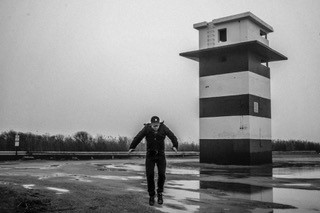
The Middle Distance, 2015

Trick or miracle—at that moment,
the desire roughly the same—it
reveals itself photographically
after taking shape in dreams, like one
in which, if you can hold your breath long
enough to feel your spine lengthen, this
happens: you rise, unsure at first, then
hover for a moment, then you drift
with the prevailing winds until you
begin to master—if that’s the right word—
the embodied equivalent of
yaw and pitch and roll. Exhibit A:
me, here, on West Island under low
skies—my favorite World War II U-boat
watch tower in the middle distance—
out of time, it would seem, crammed with in-
betweenness, with neither-here-nor-there-
ness, rising and in—Robson’s word—free-
fall, both—a dangerous time, he’d said,
and exhilarating and cruelly
necessary. So ready, even
the body knows it—like bring-out-your-
dead ready, like you’d-think-it’s-a-sad-
thing ready, but more like slow-motion
drone footage over smoking silent
battlefields. Sad, yes, but redolent
of something like awe, the stifling grief
of too little oxygen in small
windowless summer rooms at midday.


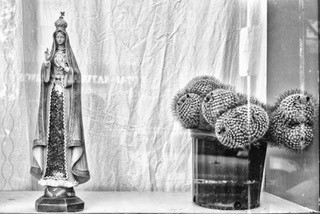
Our Lady of Cactus Spines

Our Lady of Cactus Spines,
mother of thorns, nettles, burrs,
slaps, and all that stings; of welts;

of poison oaks and ivies
and their resultant rashes;
of all irritants of the skin,

of the tongue or of the eye,
natural, inorganic,
imagined; of sharp words; of

vivid, welling memories;
and of hallucinations
that seem to rise, with shame, to

pierce the numbing spell of
endless city walks along
otherwise forgettable

streets, years or decades on. Look
down, gentle one, O, mother
of pain’s potential most pure,

of what is or is not to
come. Mediatrix most meek
and mild, pray for—puncture—us.


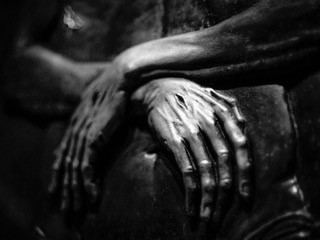
St. Rita’s Shrine, Philadelphia

Only the doors down into the shrine—
to a desiccated portion of
the saint’s flesh (itself sequestered)—are

unlocked. Above, the drama of the
cathedral; below, the chronically
touch-starved find reprieve. She’s the patron

saint of the impossible, or one
of them. But it’s flesh you can’t touch. What
you can touch: a bronze bas-relief Christ,

pierced hands crossed delicately at the
wrists and caressed to luster by the
grimy oil of human finger tips

anonymous and unnumbered, made
holy, in time, by unstigmatized
palms, the wounds’ edges brightest of all.

Tami Haaland

Tami Haaland is the author of three poetry collections, most recently What Does Not Return. Her poems have appeared in many periodicals and anthologies, including, Consequence, The American Journal of Poetry, The Ecopoetry Anthology, and Healing the Divide.  Her work has also been featured on The Writer’s Almanac, Verse Daily, and American Life in Poetry. Haaland has served as Montana’s Poet Laureate and teaches at Montana State University Billings.

Three Poems ~ Tami Haaland

Scene: Late Summer

Long time since a bird slammed
into a window, though it’s the season.
Rowan berries are plump and birds
are feasting. This one, a robin,
fell flat on the porch then stood,
staggered, mouth open and panting.
Gradually his eyes brightened
and he looked almost ready to fly.
I returned to my papers, my watcher
having watched the revival until the bird’s
cheeping startled me upward again.
Why didn’t I think of the neighbor’s cat?

After my protector fumbled, my rescuer
went for the locked door and knew
it would be too late. My coward
suppressed a knot in the belly
and turned away until the cat
disappeared beyond the window frame,
bird in its jaw. Nature, I thought.
No, a well-fed cat, said my ironist.
My Romantic, who has always clung
to the losses and wanted the perfect
ending despite my editor’s cutting
remarks, cried, a poor robin gone


Sewing Room 1973

In the hot back room meant to be
a dressing room, as if dressing
had to be set apart, there were two
oak chests full of treasures, letters
and jewelry, and a heavy sewing machine,
dated and, according to my mother,

never quite right. I would sit there
on hot summer days, light pounding
from curtainless windows, AM radio
turned up on Gladys Knight and the Pips,
Motown hits, and Diana Ross, who was
the most beautiful woman ever,

and I made school dresses in bright
polyester, the subtle smell of sewing
machine oil an undertow, me in my tank top
and shorts, a sweaty kid taking destiny
in hand, dreaming up a future to the whir
of the open belt and chuffing needle.


Kelp Forest, Monterey Aquarium

Small leopard shark, do we
lean into each other? Your eye

and my eye, my curiosity
and yours? And you, lovely rockfish.

I see how some of you turn to the sun,
to schools swirling above you

or how you gather, an audience
for these faces facing in.

Baby watches me watching
anemones, watching tentacles,

humans schooling
like anchovies.

Living sand dollars,
darling stars and jellyfish,

humans must seem like
big-guy fish.

Baby ray reaches up the side
of its tank like a puppy.

My Enlightenment ~ T.R. Hummer


I lost my mojo back in 1982
     when Reagan was president. A lot
Went on. I was sore confused.
     I spent my mornings playing Texas Hold’em
With a gentleman’s gentleman from Austin
     who taught me Western Swing
Chord progressions on the steel guitar,
     “The greatest American music,”
He kept insisting, but I held out
     for the murder ballad, mostly
Out of sheer perversity. “Un-
     American, son” he rightly argued,
“But,” I countered, “Those Bob Wills songs
     are just too happy,” and it always shut him up.
You can’t dispute that great art shouldn’t
     make you suicidal, though neither of us
Believed it. Happiness is simply disgraceful
     among philosophers of academe.
That was decades ago, and the country
     kept choosing happiness, the smiling
Actor swiping the national credit card,
     and I went on in the deepest kind of sorrow,
Humming “Big Ball’s in Cowtown,”
     running the changes in “The Rose of San Antone.”


Allison Joseph

Allison Joseph lives in Carbondale, Illinois, where she is Professor of English and Director of the MFA Program in Creative Writing at Southern Illinois University.  She serves as poetry editor of Crab Orchard Review.  Her most recent full-length collection, Confessions of a Barefaced Woman was published by Red Hen Press in June 2018 and is the Gold/First Place winner of the 2019 Feathered Quill Award in Poetry and is a nominated work for the 2019 NAACP Image Award in Poetry. She is the literary partner and wife of poet and editor Jon Tribble.

Three Poems ~ Allison Joseph

Game of Life

Little blue pegs for boys, little pink pegs for girls—
load up your plastic car with pretend children
and off you go—everything dependent on the game’s

flimsy wheel and knob spinner that flicked
off the spaces to move ahead or back, college
in your future or not, all of us lusting to land

on those payday squares. Oh that lovely fake
money that bought us fake houses with fake
garages for our little plastic car full of our ugly

plastic peg-children we never bothered to name.
I can’t remember learning any valuable lesson
from this game—no greed like Monopoly,

no steady hands like Operation, no longing
for a cardboard dude behind a Mystery Date
door. We played on rainy afternoons in someone’s

mama’s basement, or heat-dazed in summer
camp when counselors grew sick of our slack
faces, whiny demands. But now I know

it prepped me for all this: irrational deeds
and wicked turns, fickle fortunes and
so many narrow paths to navigate, all

the permutations of ugly luck and bankruptcy.
Some days I wish it were as easy as spinning
again then moving ahead those necessary

spaces, reading the fine print of wherever
I end up, directions printed on the inside
of the box it all came in, all the pieces
settled back inside once my game is done.

Nothing Quite Like It

There’s nothing quite like losing
to make you feel alive
that ripening called bruising
the way you’ve failed to thrive

to make you feel alive
to crack your self-esteem
the way you’ve failed to thrive
no suit, no shoes, no team

to crack your self-esteem
there’s nothing like a loss
no suit, no shoes, no team
can mitigate that cost

there’s nothing like a loss
to wreck you back to life
can’t mitigate the cost
of all that strident strife

to wreck you back to life
to breathe you into doubt
and all that strident strife
you won’t be letting out

to breathe you into doubt
that ripening called bruising
you won’t be getting out
of all you know of losing

In Praise of Resting Bitch Face

Oasis in a sea of crazy,
my face does not betray me.
Discomfort in my mind
not revealed by my features,
expressionless rage my forte.

Paragon of passive anger,
epic oxymoron. No tics
for you to read me by,
no access to my secrets
through any smile or smirk,

grin or blush. Solemn
column, no sweetness for you
to turn to weakness, no
vulnerable spike in heart
rate or breathing. You

will not defeat me, cara mia,
with your questions, loaded
queries that leave me weary.
This face will not reveal
unto you what which you

want it to—will not give you
the time of day, week, or year,
will not rage for your catharsis.
I am not your vessel, your
heartache, your chalice

at the altar rail. You will
not drink from me, so seek
salvation elsewhere—access
denied to this brow, this stage
this platform free of any revelation.

Jesse Lee Kercheval

Jesse Lee Kercheval is a poet, fiction writer, memoirist and translator. Her lastest books include the poetry collection America that Island off the coast of France, winner of the Dorset Prize, and the short story collection Underground Women. She is currently the Zona Gale Professor of English at the University of Wisconsin-Madison.